Paintings on Canvas & Glass — Parallel to Daubism
This second shop brings together two enduring strands of my work: paintings on canvas and paintings on glass. These practices did not arise as offshoots of Daubism but have accompanied it from the beginning—growing alongside, informing, and sometimes gently contradicting the Daubist interventions that began in 1991. My broader art practice reaches back to 1985, and these works belong to that longer arc.
The glass discs—painted on 30 cm rounds—extend from the beloved Bridgewater Glass Disc Installation of 2020, where hand-painted discs appeared across the Adelaide Hills during lockdown as small gifts of colour, humour, and neighbourly solidarity. Each disc in this collection carries the same sensibility: intimate, playful objects that turn an everyday material into a quiet form of public joy.
The canvas works begin with a blank surface rather than an existing painting, allowing imagery to emerge freely rather than in response to a prior scene. They inhabit their own imaginative territory—loose, bold, and instinctive—echoing children’s drawings, outsider art, and the liberated mark-making that sits at the heart of so much of my work. These paintings have accompanied me throughout decades of making, operating in parallel to the appropriation-based framework of Daubism.
Placed together, the canvas paintings and glass discs form a companion practice to the Daubist works: not secondary, not derivative, but another way of exploring the same long-running questions about reinvention, play, community, and the elastic boundaries of what an artwork can be.
Welcome to this parallel studio world—running beside Daubism for forty years, and still expanding.
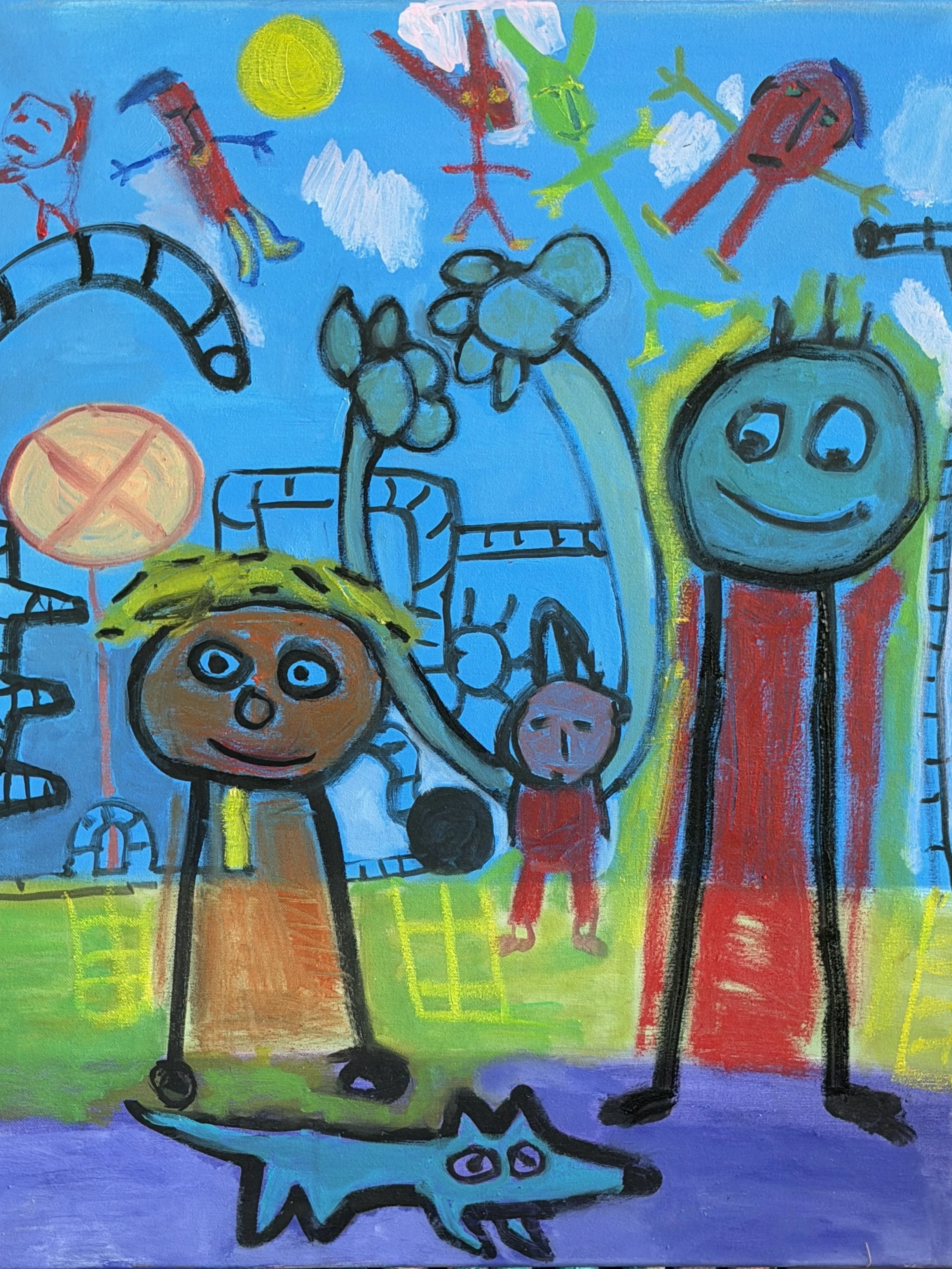
The Playground, 2025
Oil on canvas
60 cm W × 75 cm H
The Playground is a jubilant translation of real children’s drawings—images originally published in the Sunday paper’s comic section and carefully collected by the artist over time. Reinterpreted in oil paint, these marks retain their original looseness and raw invention, yet take on a new presence when scaled up and rendered through an adult hand attuned to the anarchic genius of childhood drawing.
Figures stretch and tilt with wild confidence. A smiling blue giant raises an arm in greeting, while a smaller figure—both earnest and bewildered—holds on tight. Above them, airborne characters tumble through a bright sky; below, a turquoise dog trots forward with cartoon certainty. The entire scene hums with movement, colour, and the unselfconscious logic found only in the imaginative worlds of children.
In this work, Armstrong doesn’t imitate childishness—he collaborates with it. The result is a painting that sits somewhere between play and homage, echoing the artist’s deep respect for the expressive clarity of children’s art, outsider art, and naïve mark-making. The Playground invites viewers back to a moment when drawing was pure invention, unburdened by rules, theory, or expectation.
A lively, generous canvas that celebrates joy, spontaneity, and the wild architecture of childhood imagination.
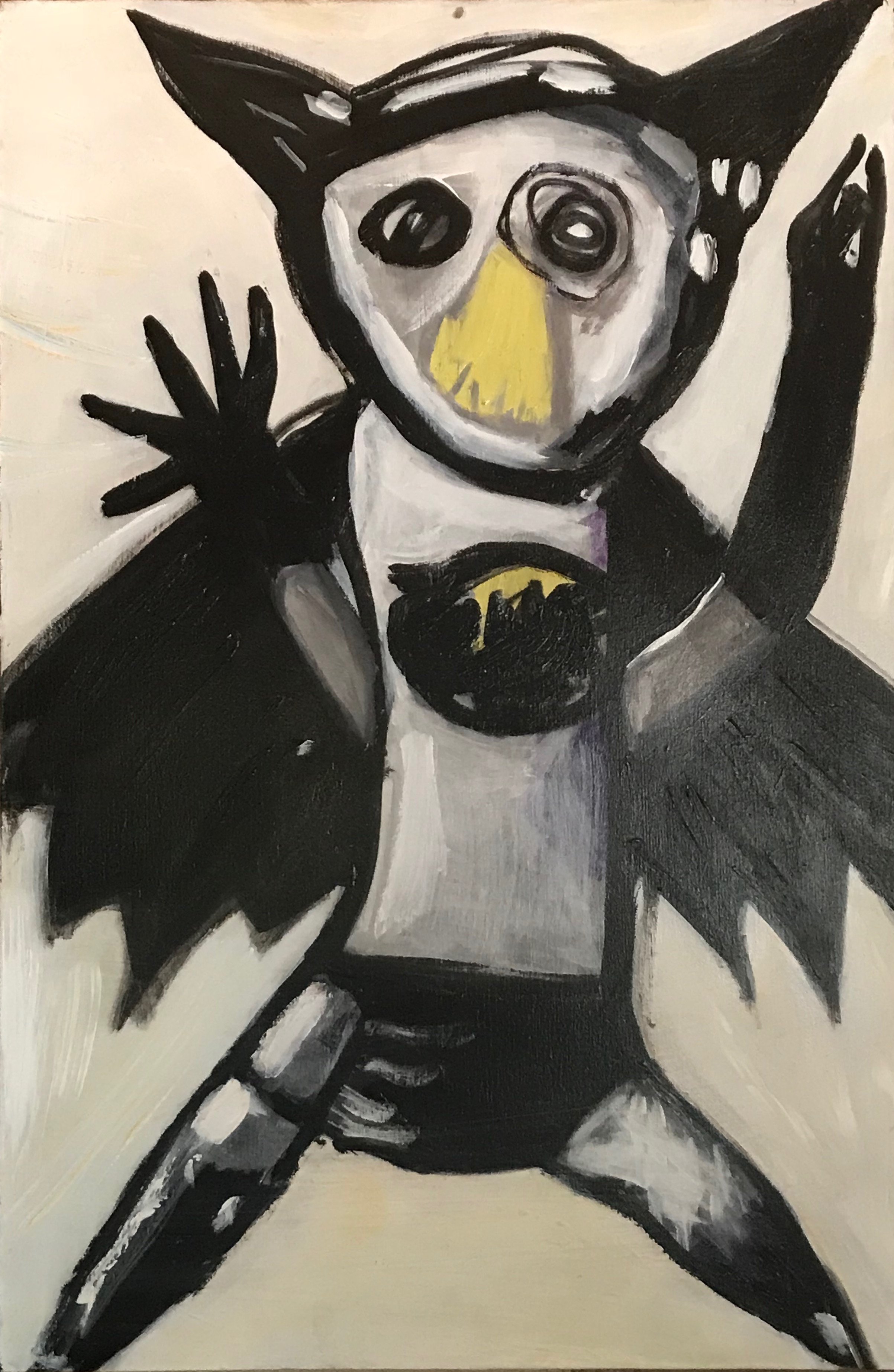
Batman (2017)
71 cm W x 92 cm H - Acrylic on canvas
This work continues a practice that has been with the artist since the very beginning: the collecting and reimagining of children’s drawings, especially those published in the Sunday paper. Long before Daubism emerged in 1991, these images captivated Armstrong—not for their innocence, but for their unfiltered psychological directness. Children draw what they feel before they draw what they see, and nowhere is that clearer than in this extraordinary depiction of Batman.
Blown up from a tiny crayon original into a bold acrylic painting, the character becomes something raw, expressive, and strangely truthful. The figure is crooked, off-balance, wide-eyed; his mask is uneven, his cape jagged, his emblem more like a scribble of fear and power than a polished logo. Yet in these distortions lies a deeper fidelity. This Batman is not the slick Hollywood superhero but the dark, brooding creature children understand instinctively—a figure made of shadow, worry, vigilance, and play.
Armstrong’s reinterpretation doesn’t clean up or correct the child’s drawing; it honours its urgency. The gesture is both homage and amplification. By enlarging it, he allows the emotional intensity of the original to occupy real space—to become a proper painting, not just a fragment from a newspaper insert.
The result is a work that operates in two registers at once: humorous in its rough charm, yet undeniably haunting. It reveals the way children often grasp the essence of a mythic figure long before adults have finished explaining it to them.
This Batman, in all his uneven gravity, may be the most honest Batman of all.
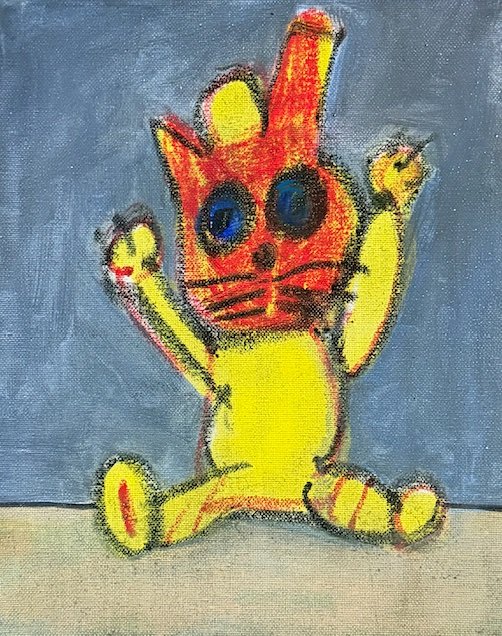
Study in Yellow and Red, 2025
H 30 cm W 25 cm - Oil on canvas
A compact, energetic painting derived from a child’s drawing and translated into oil. Raw lines, bold colour, and a deliberately unstable figure give the work its strange, magnetic presence.
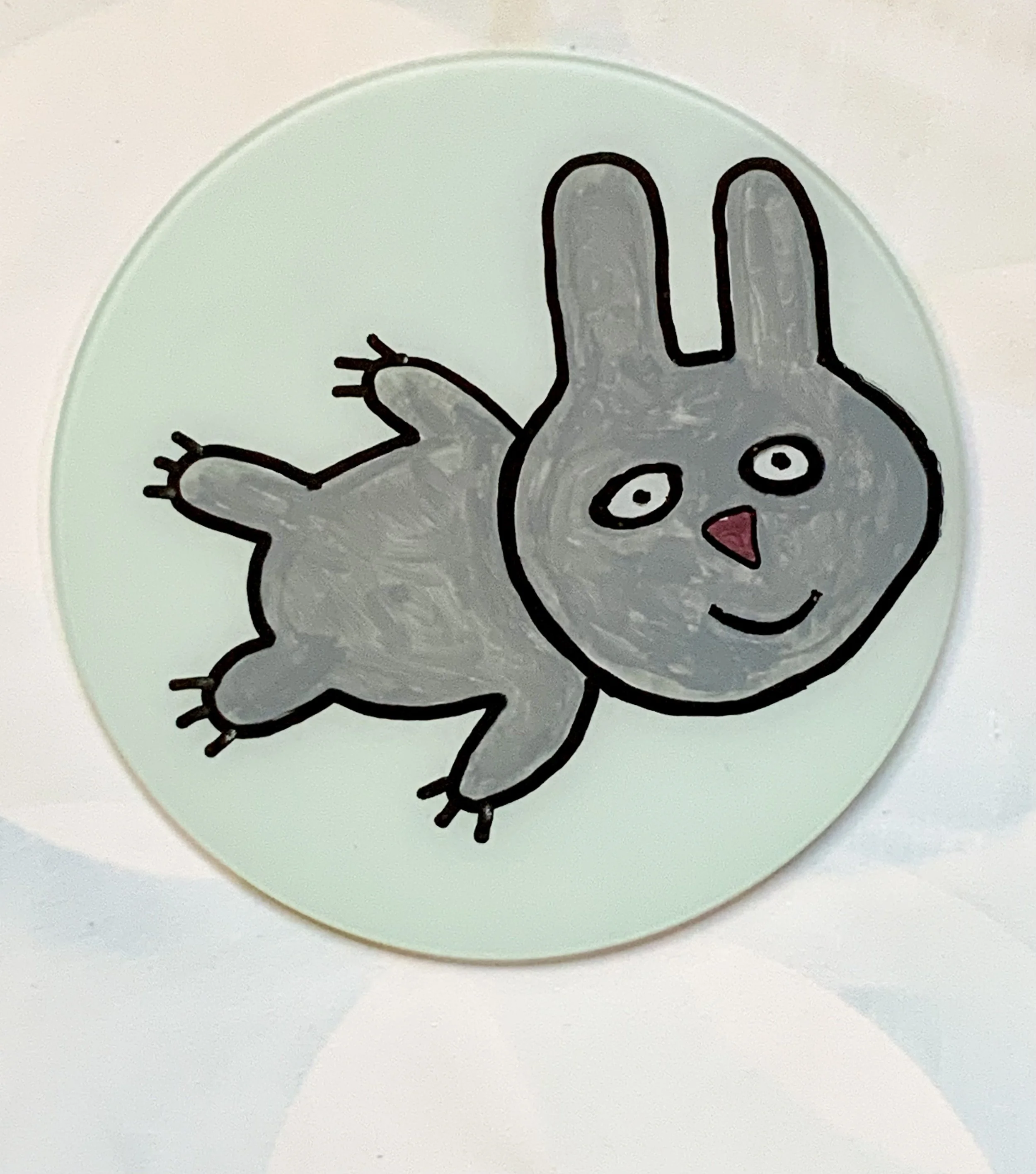
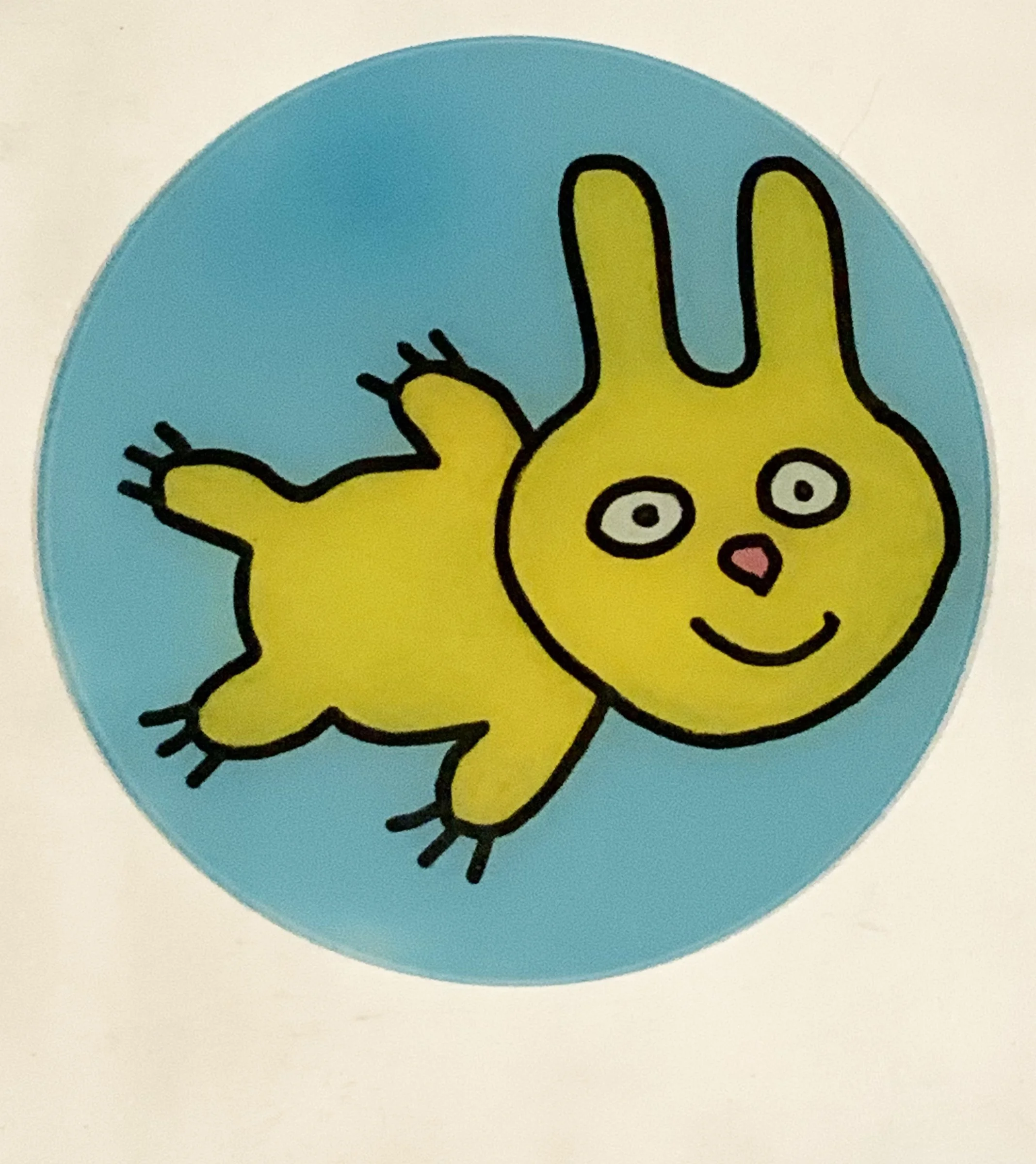
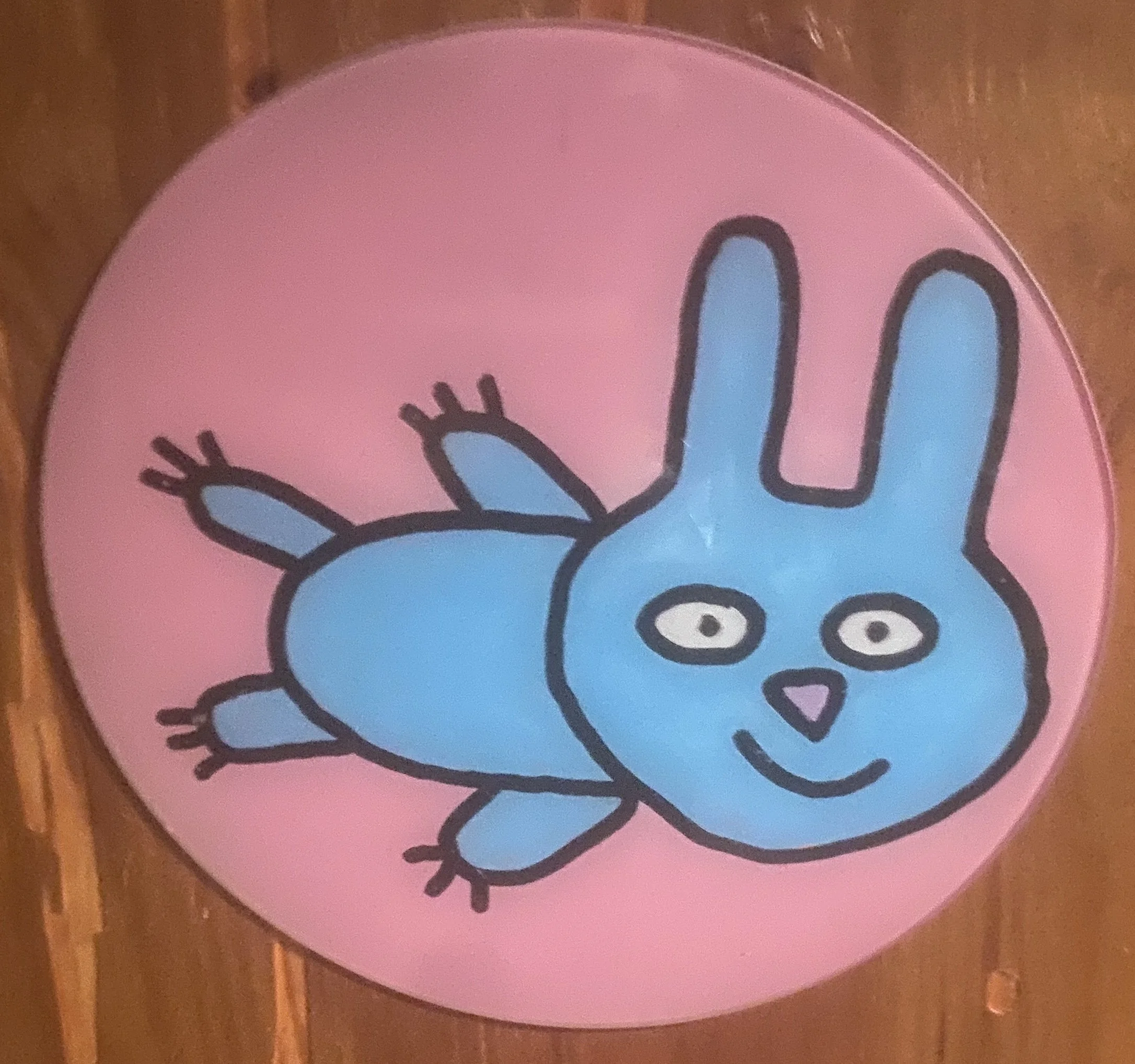
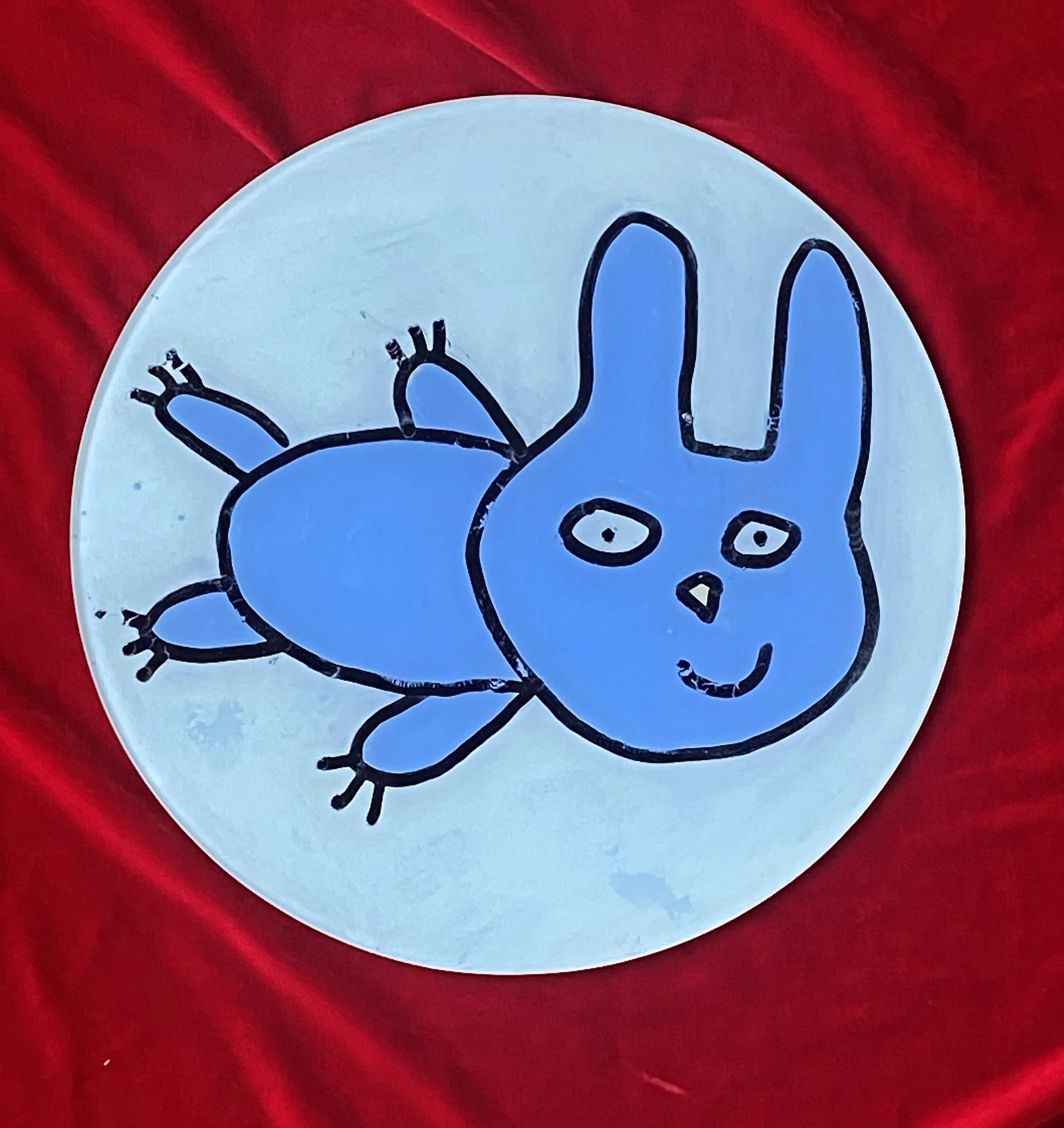
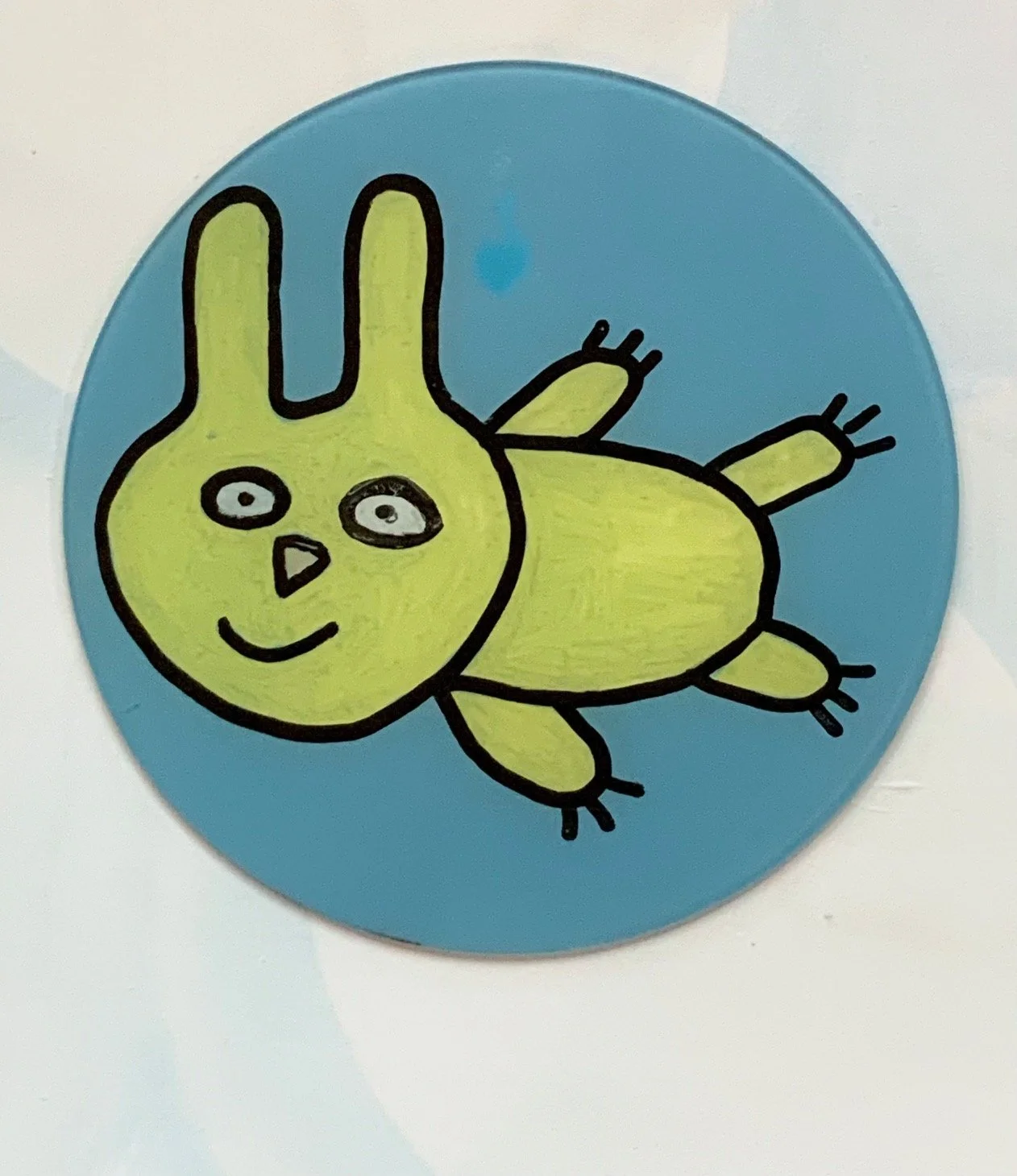
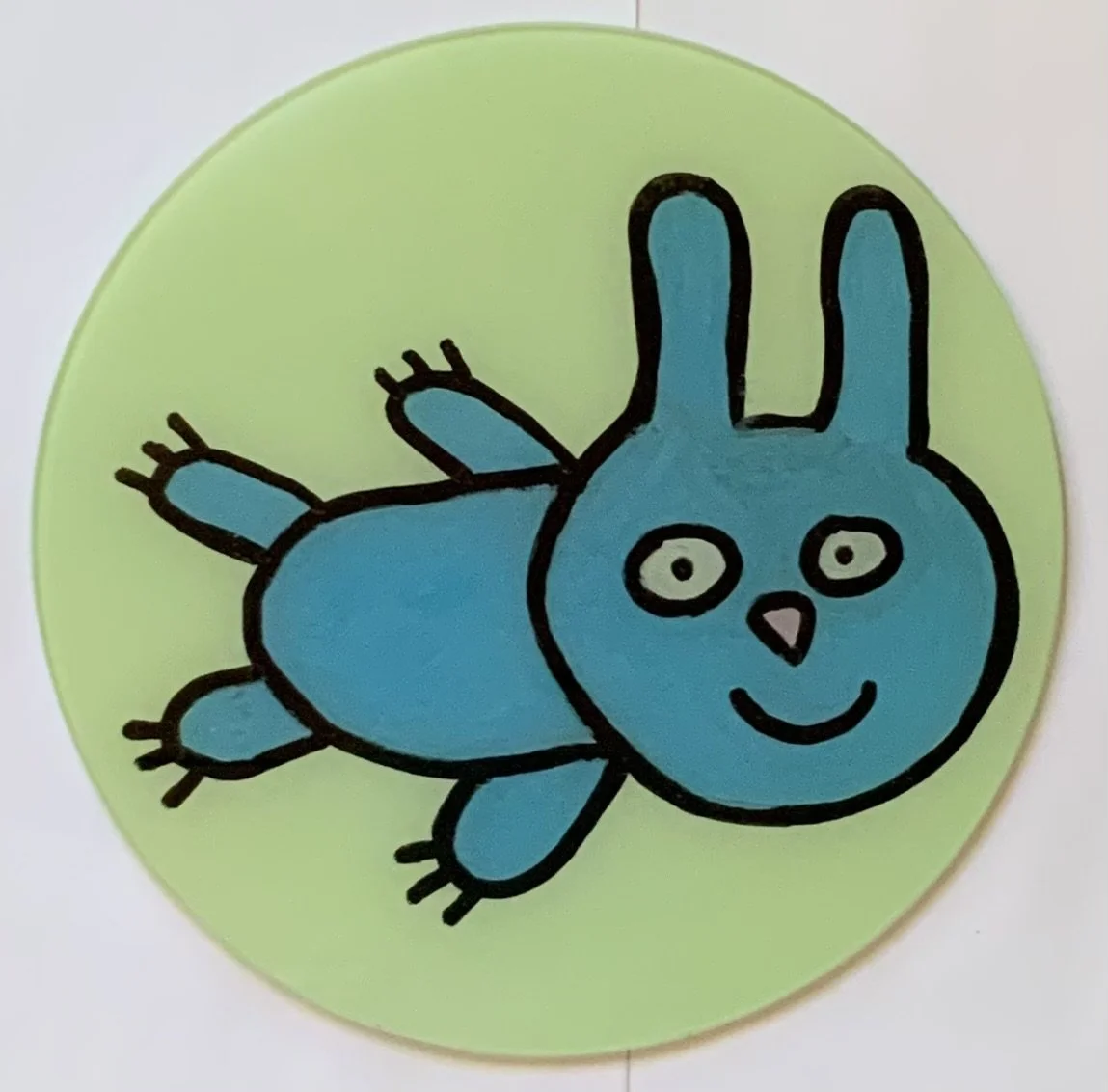
Bunny, 2024
Hand-painted on 30 cm glass disc — $725 (includes wall mount plate holder, plus postage)
This lively Bunny character began as a child’s drawing photographed by the artist on a school wall beside a pedestrian footpath in Tokyo. Something about its proportions, charm, and quiet strangeness stayed with him, and the Bunny has since reappeared throughout his practice in different colours, moods, and materials.
Each disc in this series is individually hand-painted on thick 30 cm clear glass. No two are the same: every Bunny carries its own expression, colour palette, and personality. The transparency of the glass gives the figure a floating, luminous quality, echoing the spontaneity of the original Tokyo drawing while transforming it into a collectible artwork.
You may order a custom Bunny in any colour range, facing left or right — your choice.
A joyful, contemporary object that bridges street observation, children’s art, and the ongoing evolution of the artist’s iconography.

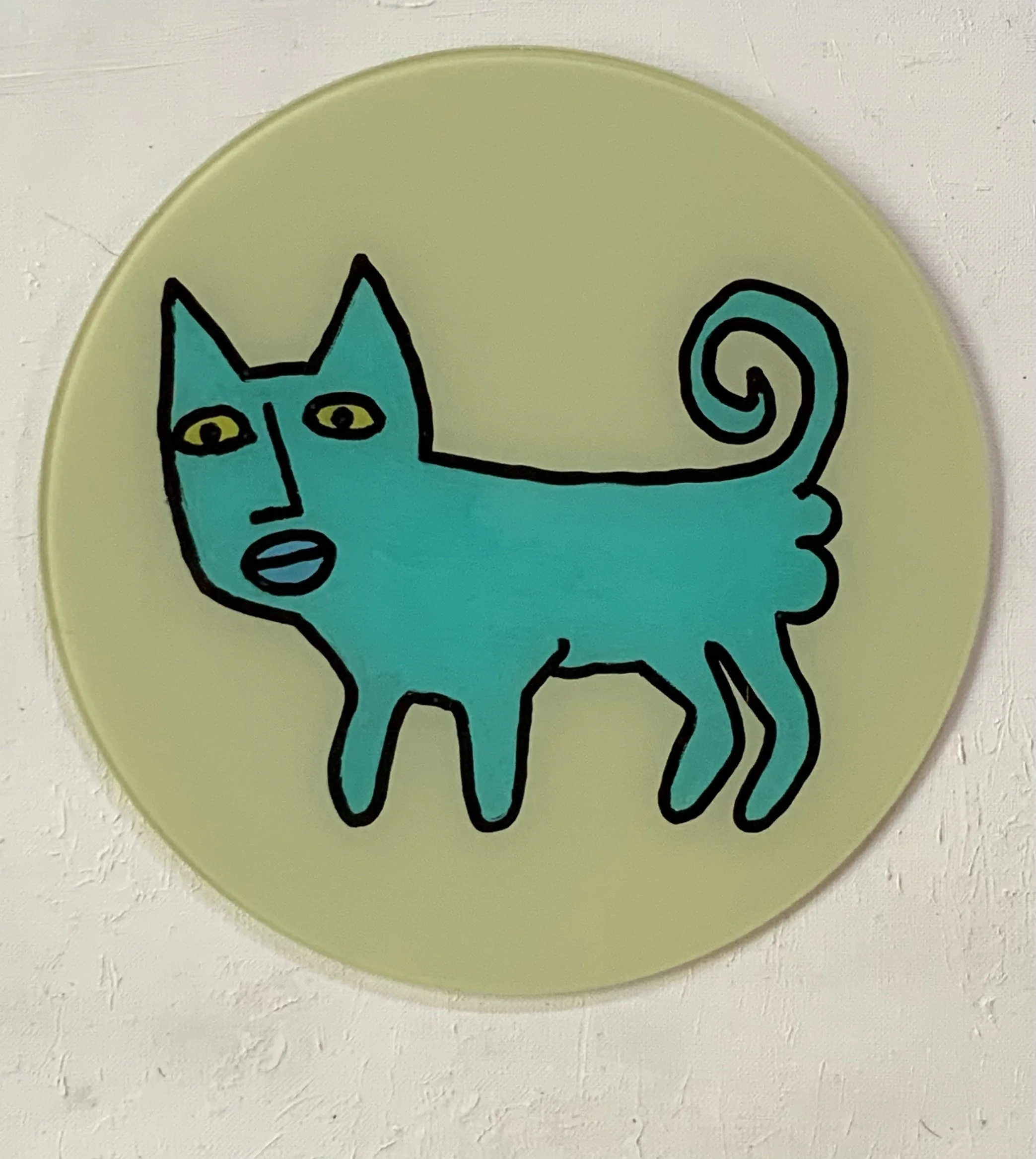
Bakaneko, 2024
Hand-painted on 30 cm glass disc - $725 (includes wall hanging plate holder + postage)
Bakaneko, 2024 draws its lineage from two sources that have shaped the artist’s practice for decades: the anarchic brilliance of children’s drawings and the rich, shape-shifting world of Japanese folklore. In Japan, the bakaneko is a supernatural cat—mischievous, unpredictable, sometimes benevolent, sometimes trouble—capable of transformation and imbued with a spirit that resists tidy categorisation. Armstrong seizes upon this ambiguity and translates it through the distilled, graphic language that has become one of his signatures.
The figure itself, with its elongated body, curled tail, and blunt, declarative linework, owes its form to the childlike iconography the artist has long collected and reinterpreted. Children’s drawings, in their boldness and disregard for realism, often reach the essence of a character more directly than adult renderings. Here, the cat becomes a symbol rather than an animal: flattened, stylised, and vivid, an emblem of playful disobedience.
Painted by hand on thick 30 cm clear glass, each disc carries a luminous presence. The transparency of the medium allows the creature to float, as though suspended between the real and the imagined—mirroring the bakaneko’s mythic ability to slip between worlds. The colour palettes shift from piece to piece, making each disc a unique variation in mood and expression while maintaining the clarity of the central form.
This work occupies a meeting point between folklore, pop sensibility, and the intuitive mark-making of childhood. It is a distilled icon, humorous and strange, familiar yet uncanny. In the artist’s hands, the bakaneko is less a storybook creature and more a contemporary totem: a symbol of wit, mischief, and the pleasure of images that refuse to sit still.
A singular piece within an ongoing exploration of glass-based works that bridge cultural reference, myth, and the raw immediacy of childlike drawing.

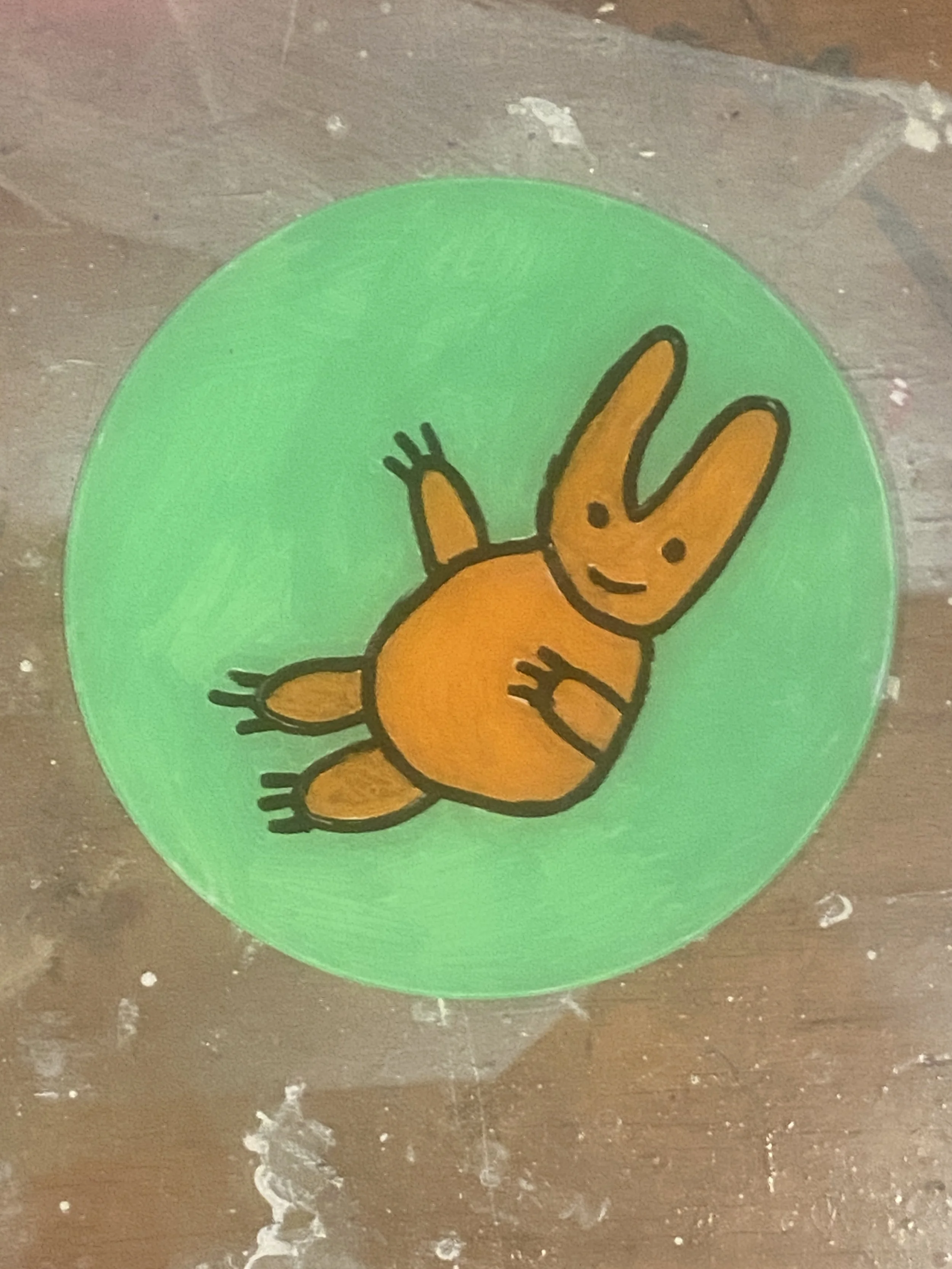
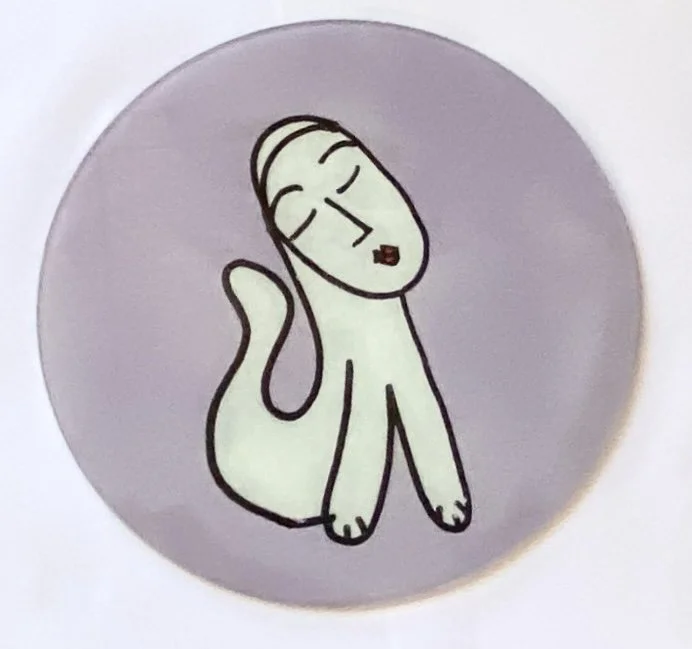
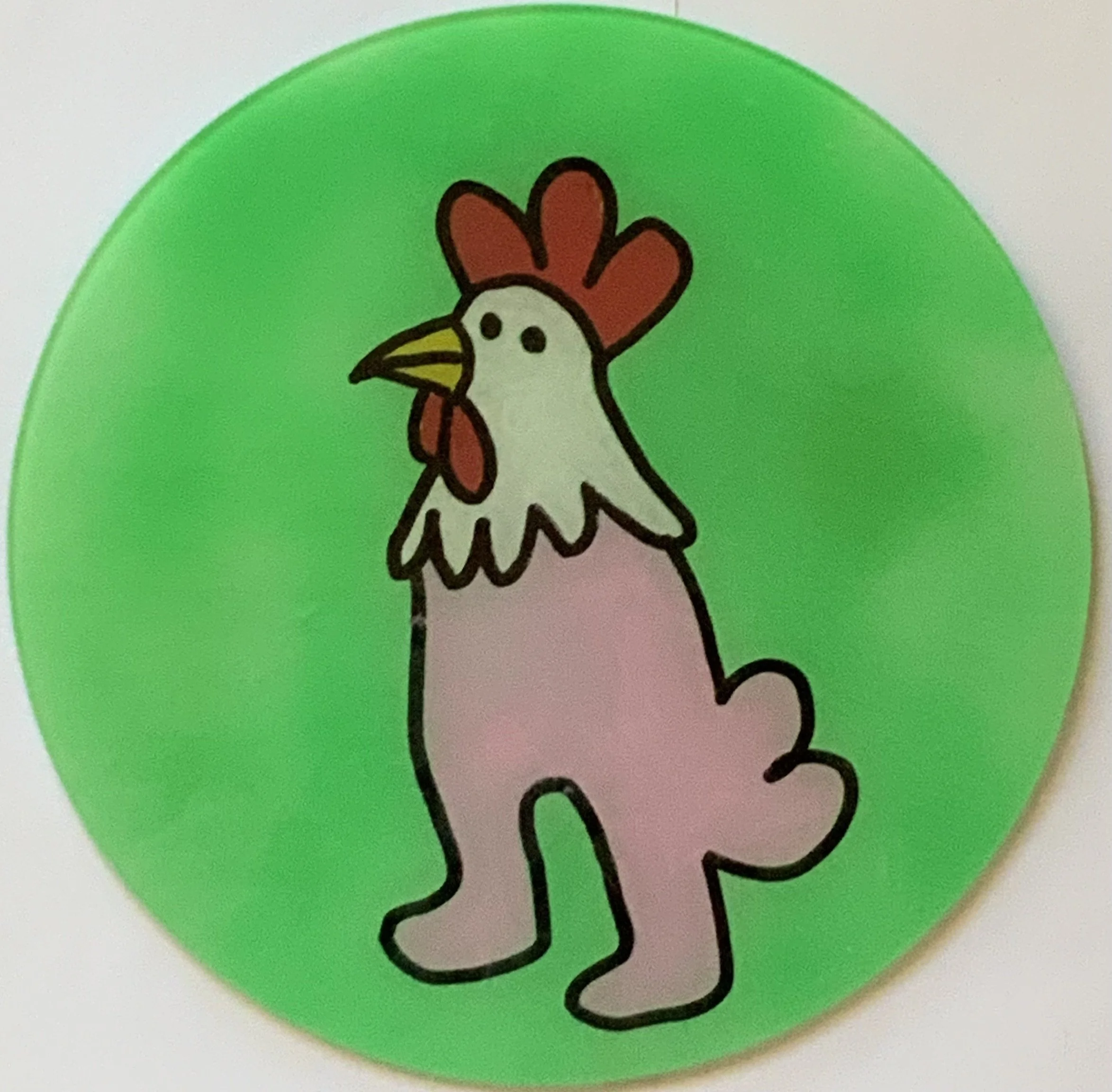
Andy Small Bunny Cesealia Cockhead
2024
$725 including spring loaded wall hanger + postage
These four discs articulate a study in hybridity, drawing on the artist’s engagement with the semiotic instability of child-generated imagery. Each figure resists singular classification: the crocodile borrows human comportment, the rabbit collapses into a graphic sign, the elongated white figure operates somewhere between anthropoid ghost and stylised glyph, and the rooster-hybrid asserts itself as an intentional compositional rupture. Their coexistence highlights a visual system in which hybrid forms are not anomalies but core structural elements. Rendered on glass—an inherently intermediary surface—they function as liminal icons, traversing boundaries between species, identities, and cultural references. In this context, hybridity becomes a mode of thinking rather than a motif, revealing how images negotiate multiple registers simultaneously.
drillerjet@me.com for all sales.
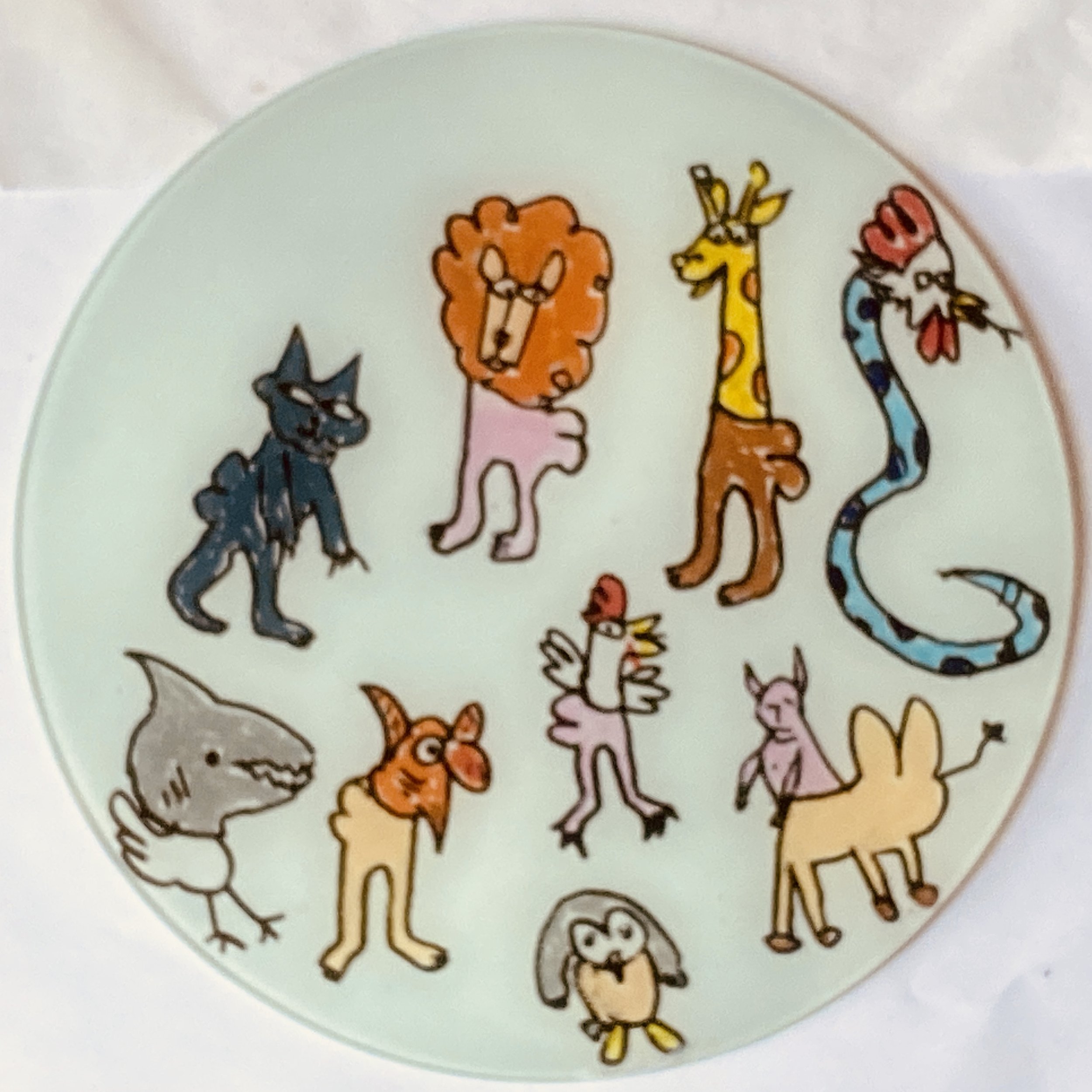
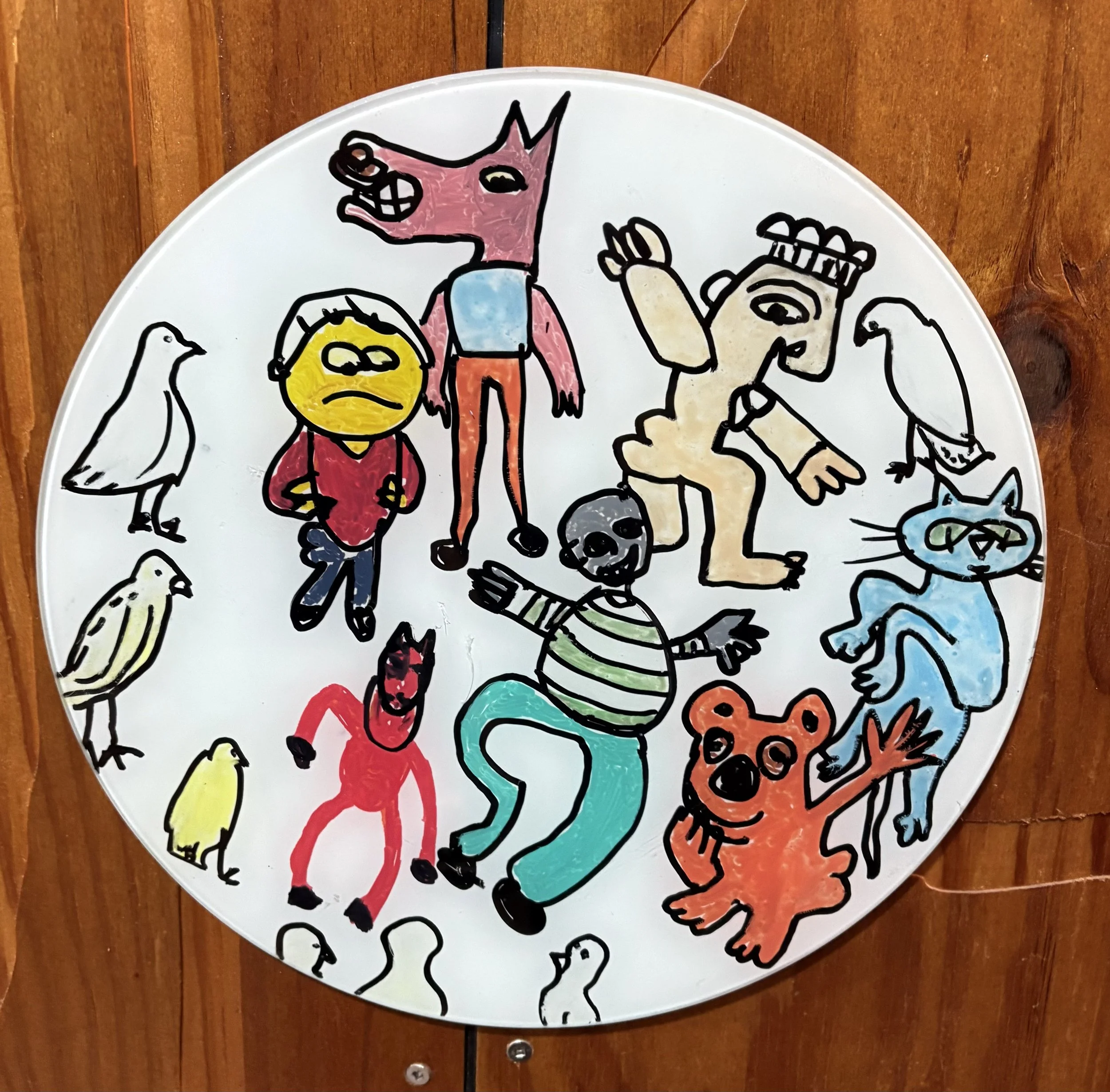
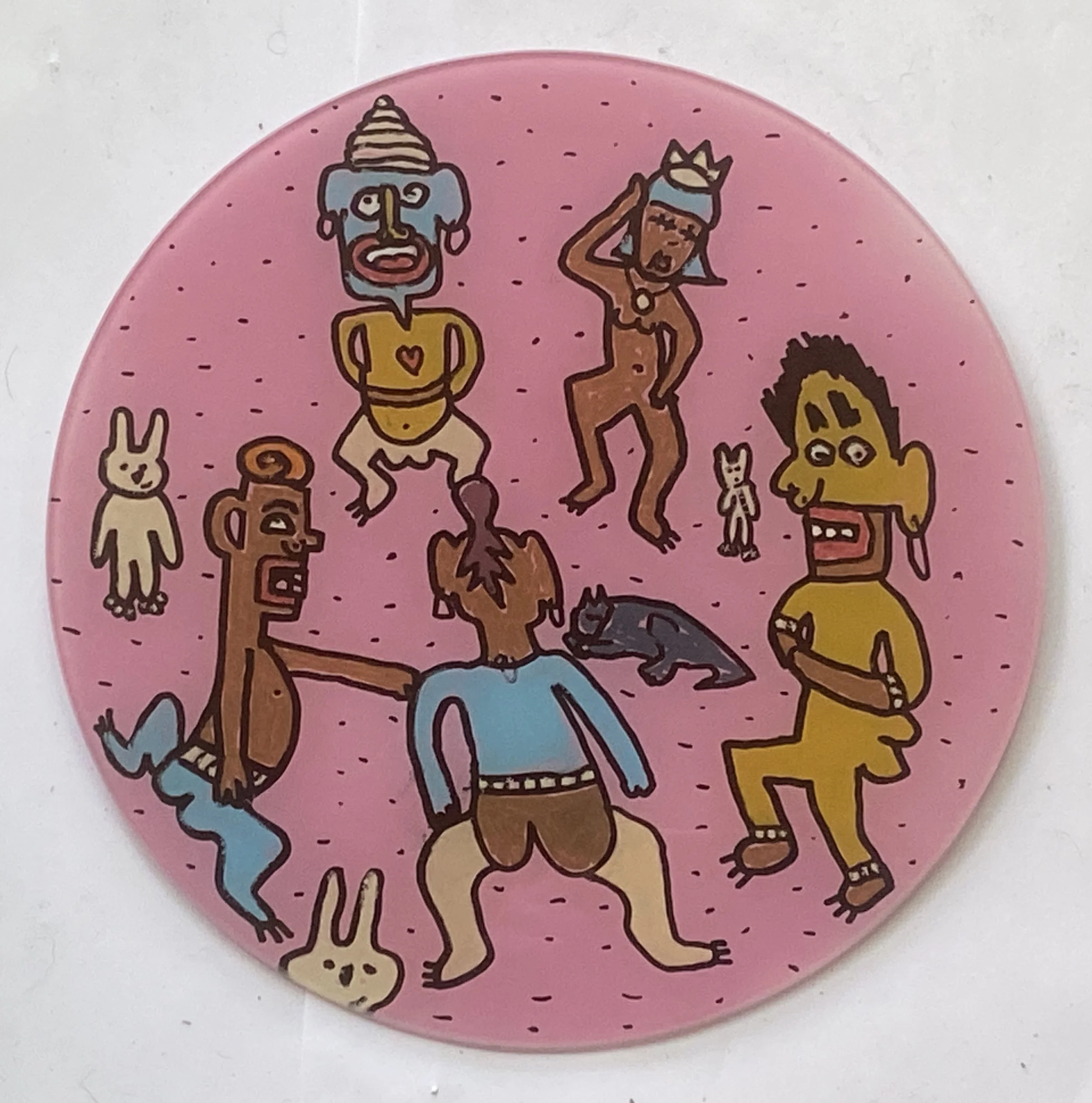
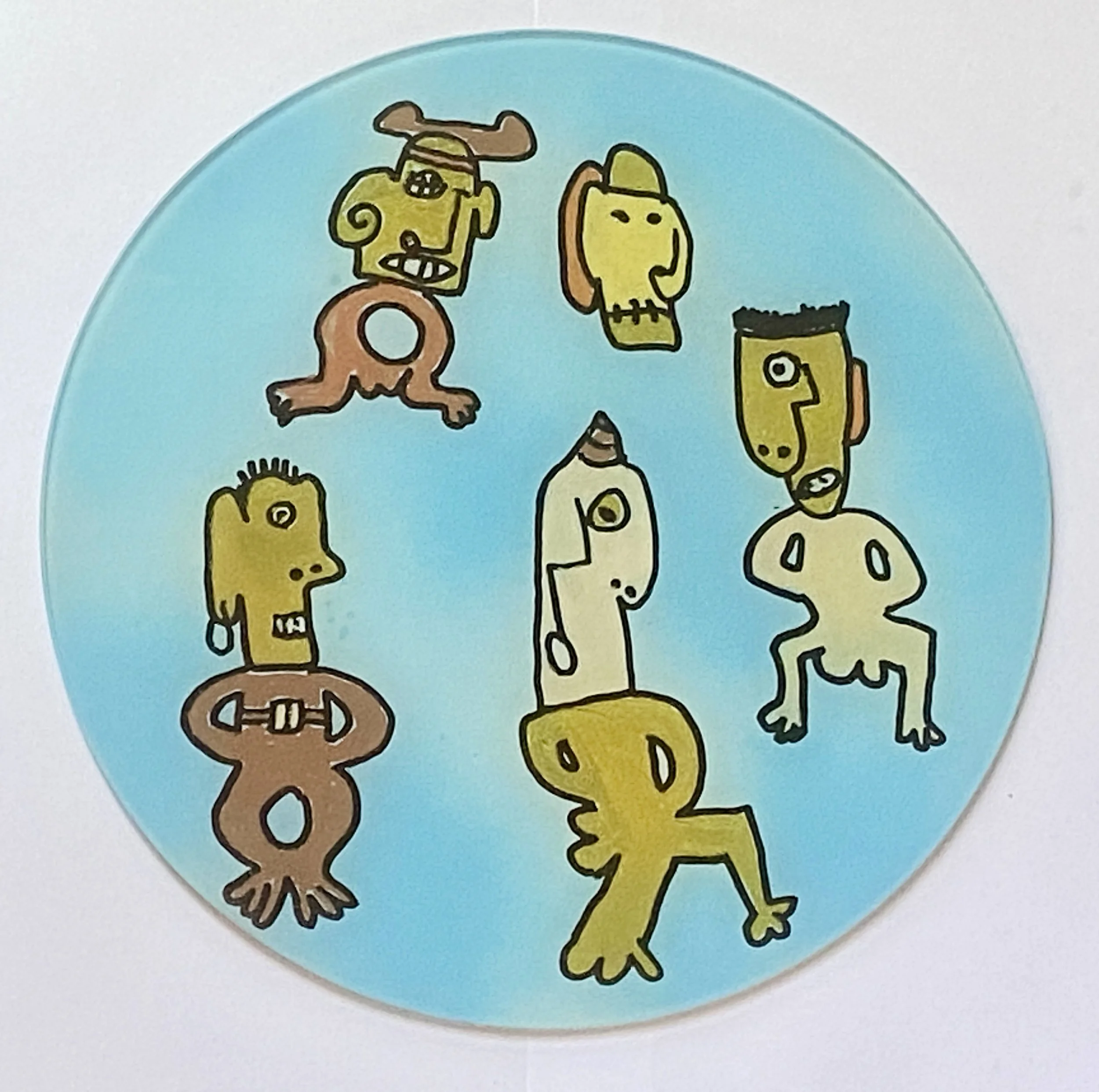
Hybrids and Tribal Culture — 2024
Hand-painted on 30 cm glass discs — $725 each (includes spring-loaded wall hanger)
This series gathers a shifting community of hybrid and tribalised figures—part animal, part human, part emblem—drawn from the artist’s ongoing exploration of how imagery mutates across cultural and imaginative registers. Each disc presents its own micro-cosm: creatures with elongated limbs, doubled anatomies, mask-like faces and improvised physiologies that recall both children’s drawings and the ritualised abstraction found in global tribal art traditions.
Armstrong uses the clarity of line and the flatness of colour to create forms that feel simultaneously ancient and contemporary. Their bodies fold in on themselves, recombine, or sprout unexpected appendages, echoing the long history of hybrid beings in myth, initiation iconography, street art, and pop culture. Painted on clear glass, they appear suspended—neither entirely decorative nor entirely symbolic—inviting the viewer to read them as provisional icons from a culture still in the process of being invented.
These works continue the artist’s fascination with the pre-linguistic image: figures that resist fixed interpretation yet carry the weight of a shared visual ancestry. They operate like fragments of a tribe that doesn’t yet have a name, but whose stories we instinctively recognise.
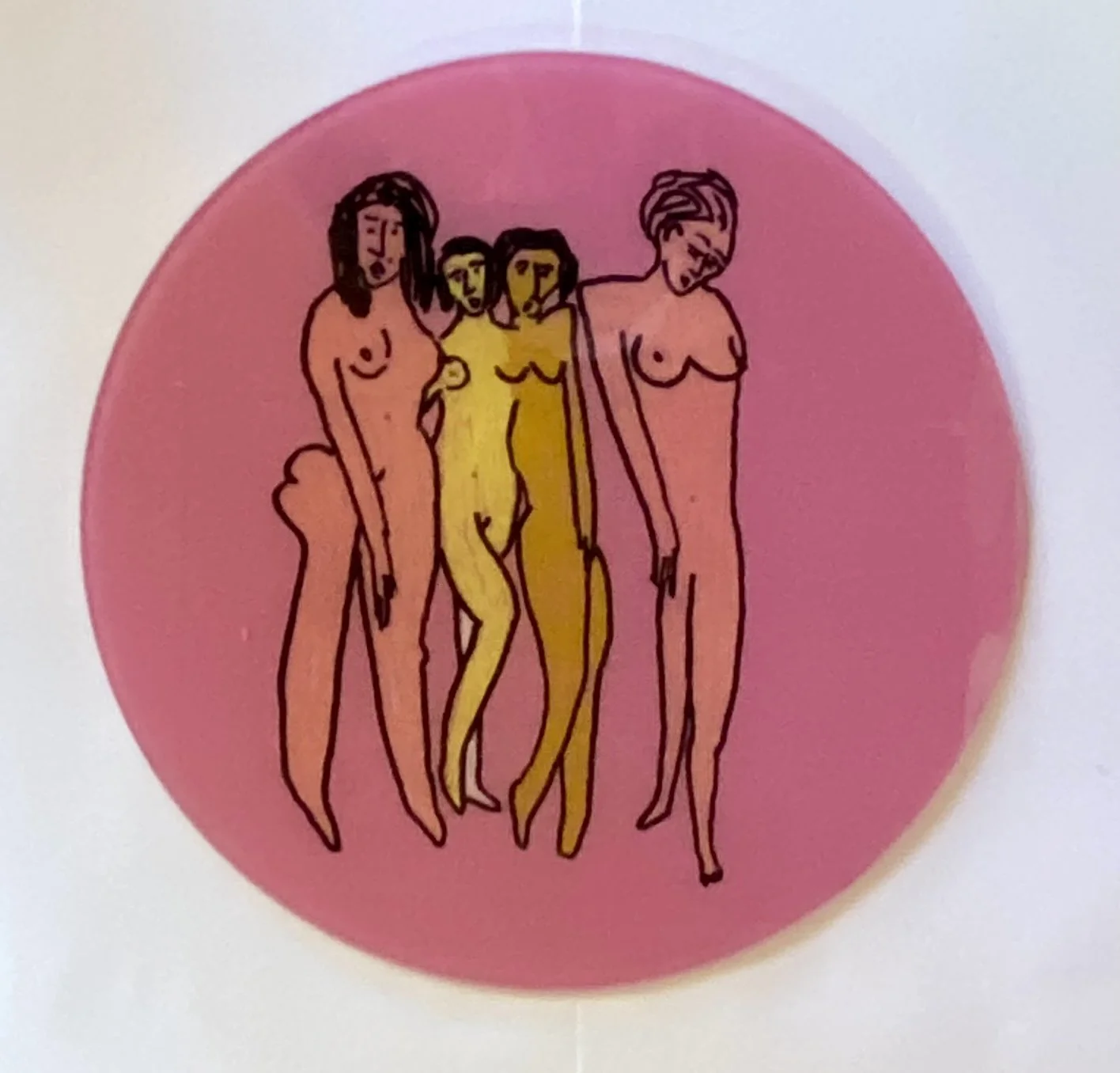
The Four Nudes (2024)
Hand-painted acrylic on 30 cm glass disc
$725 (includes spring-loaded wall hanger)
The Four Nudes assembles a small chorus of elongated, idiosyncratic bodies—awkward, intimate, and quietly conspiratorial. Their simplified forms, rendered in warm pinks and ochres, draw on Driller’s long-standing fascination with children’s art, outsider figuration, and the deliberate refusal of “proper” academic linework.
Painted in acrylic on brand-new 30 cm glass plates—objects originally designed as elegant wedding centrepieces—this series reclaims domestic ornament as contemporary art. The result sits somewhere between POP, folk aesthetics, and a gently subversive re-reading of the classical nude tradition.
Each disc is designed for gallery walls and private homes, mounted on a spring-loaded hanger that lets the work hover slightly off the surface, creating the sensation of a floating, luminous portal.
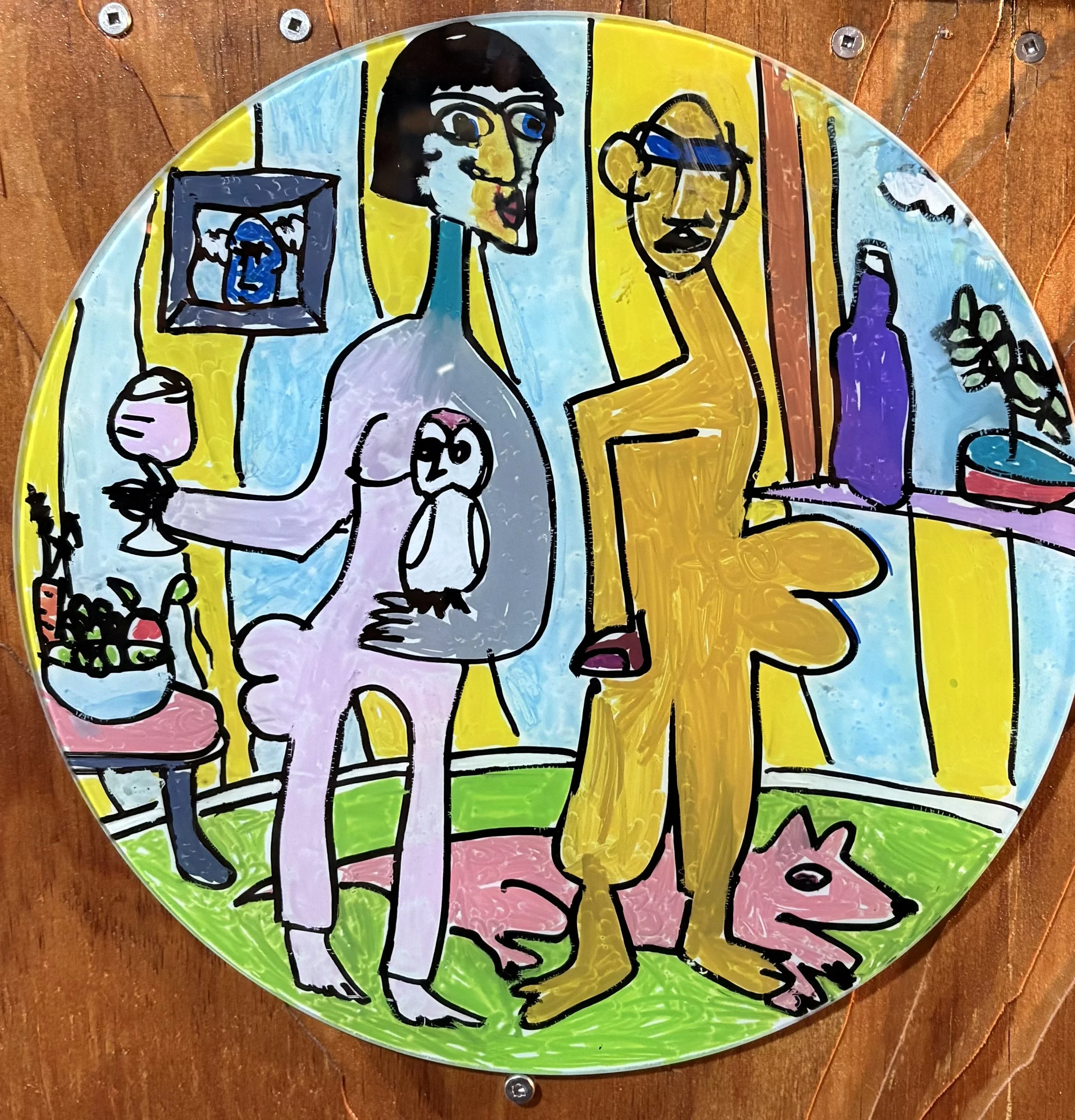
An Ideal Family (2025)
Hand-painted acrylic on 30 cm glass disc
$725 (includes spring-loaded wall hanger)
An Ideal Family is Driller’s delightfully off-centre family portrait: the artist, his wife, their dog, and—most crucially—the pet owl they once cared for. The figures are rendered as elongated, cubist-meets-cartoon silhouettes, each one slightly askew yet undeniably tender. His wife stands calmly with the owl nestled at her chest, an emblem of a shared past life and the strange, enchanting creatures that orbit a household over the years. Driller, painted in warm ochre, stands beside her in quiet companionship while their pink dog stretches knowingly across the floor, half guardian, half comic-relief.
The interior around them—striped walls, floating bottles, a framed face observing from above—feels like a room remembered rather than seen: a domestic dreamscape where all the beloved beings coexist at once, regardless of time. This is kinship rendered with humour, memory, and the visual boldness of children’s art and outsider figuration.
Painted on a brand-new 30 cm glass disc, the work elevates intimate family mythology into a luminous, circular icon. Suspended on its spring-loaded hanger, it hovers delicately on the wall, offering a portal into a home where tenderness and absurdity live side by side.
Another Friendly Face (2025)
Hand-painted acrylic on 30 cm glass disc
$725 (includes spring-loaded wall hanger)
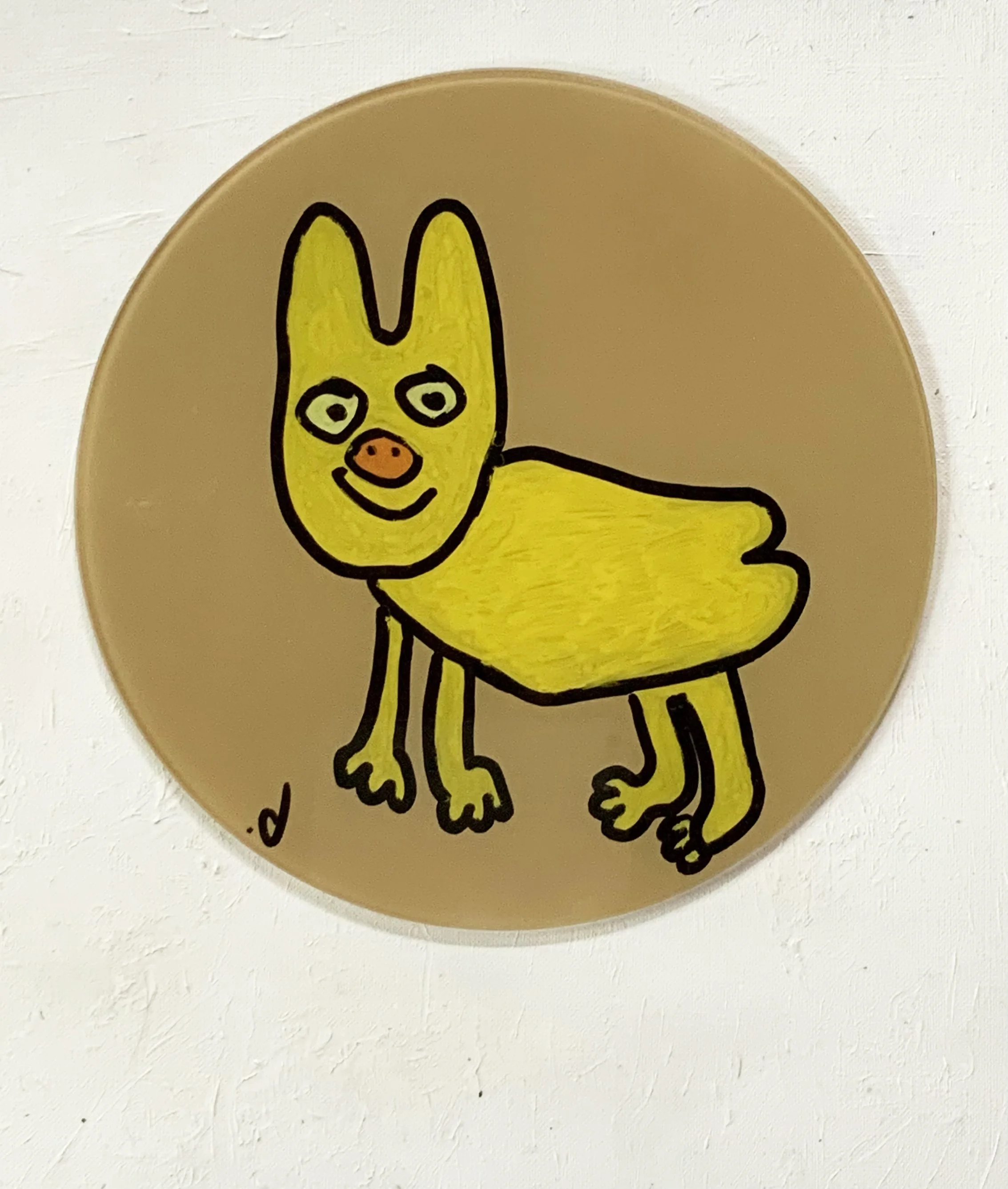
With Another Friendly Face, Driller distils pure friendliness into its most essential form: a bright yellow creature with rabbit ears, a dog’s body, a pig’s nose, and the wide-eyed optimism of a preschool drawing. It’s an impossible hybrid, yet instantly trustworthy—one of those imagined companions children invent without hesitation and adults secretly wish still existed.
The figure stands on four wobbly legs, smiling with a kind of open, uncomplicated joy. As with many works in Driller’s recent disc series, the creature feels like it stepped out of a child’s sketchbook, wandered through POP art, and decided to stay. Its beige ground keeps things calm and spacious, letting the character float comfortably in its own little universe.
Painted on a brand-new 30 cm glass disc, this piece functions like a circular talisman: a small portal of kindness for gallery walls and private homes. Mounted on its spring-loaded hanger, it hovers lightly—a cheerful guardian with no agenda except to exist, delightfully, in the room.
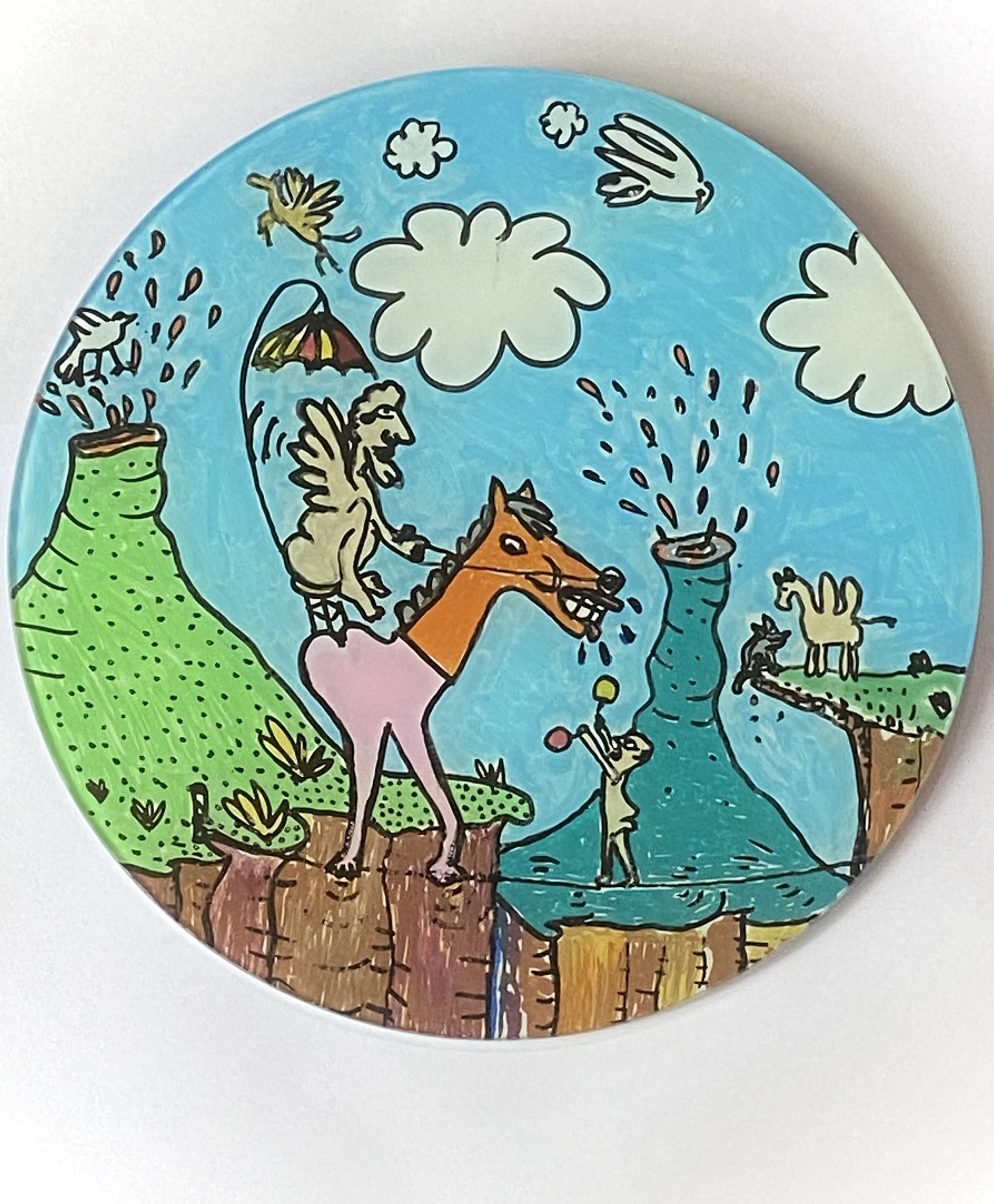
Balancing Act (2024)
Hand-painted acrylic on 30 cm glass disc
$725 (includes spring-loaded wall hanger)
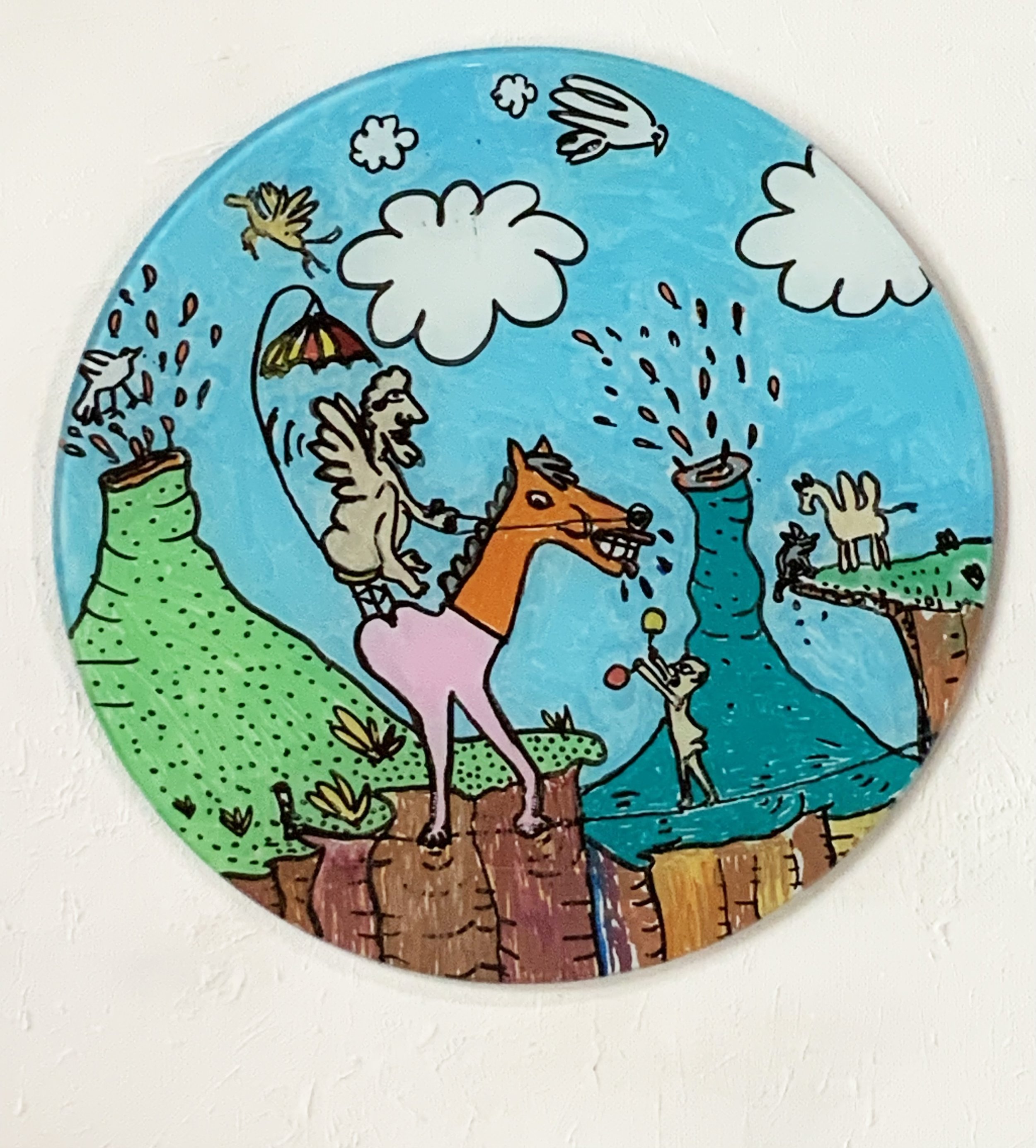
Balancing Act unfolds like a fever-dream landscape where everything is in motion and nothing obeys gravity. A winged, bearded rider clings to a horse with improbable pink hindquarters as it tiptoes along the edge of a cliff. Nearby, a lone figure juggles coloured balls beside a spurting volcanic form, while flying creatures, parachuting beings, and cloud-animals drift casually through the sky.
This work channels Driller’s love of chaotic narrative—those sprawling childhood drawings where every corner contains a new subplot. It’s a world of miniature dramas and parallel stories, all happening at once: a comic cosmology populated by hybrids, adventurers, and airborne tricksters.
The circular format intensifies the sense of a contained universe, a self-sufficient diorama of absurdity and joy. Painted in acrylic on a brand-new 30 cm glass disc, Balancing Act becomes a playful meditation on chaos, risk, and the exhilaration of keeping one foot (or hoof) on the cliff’s edge. The piece hovers lightly on its wall mount, a portal into a realm where logic has politely stepped aside to make room for wonder.
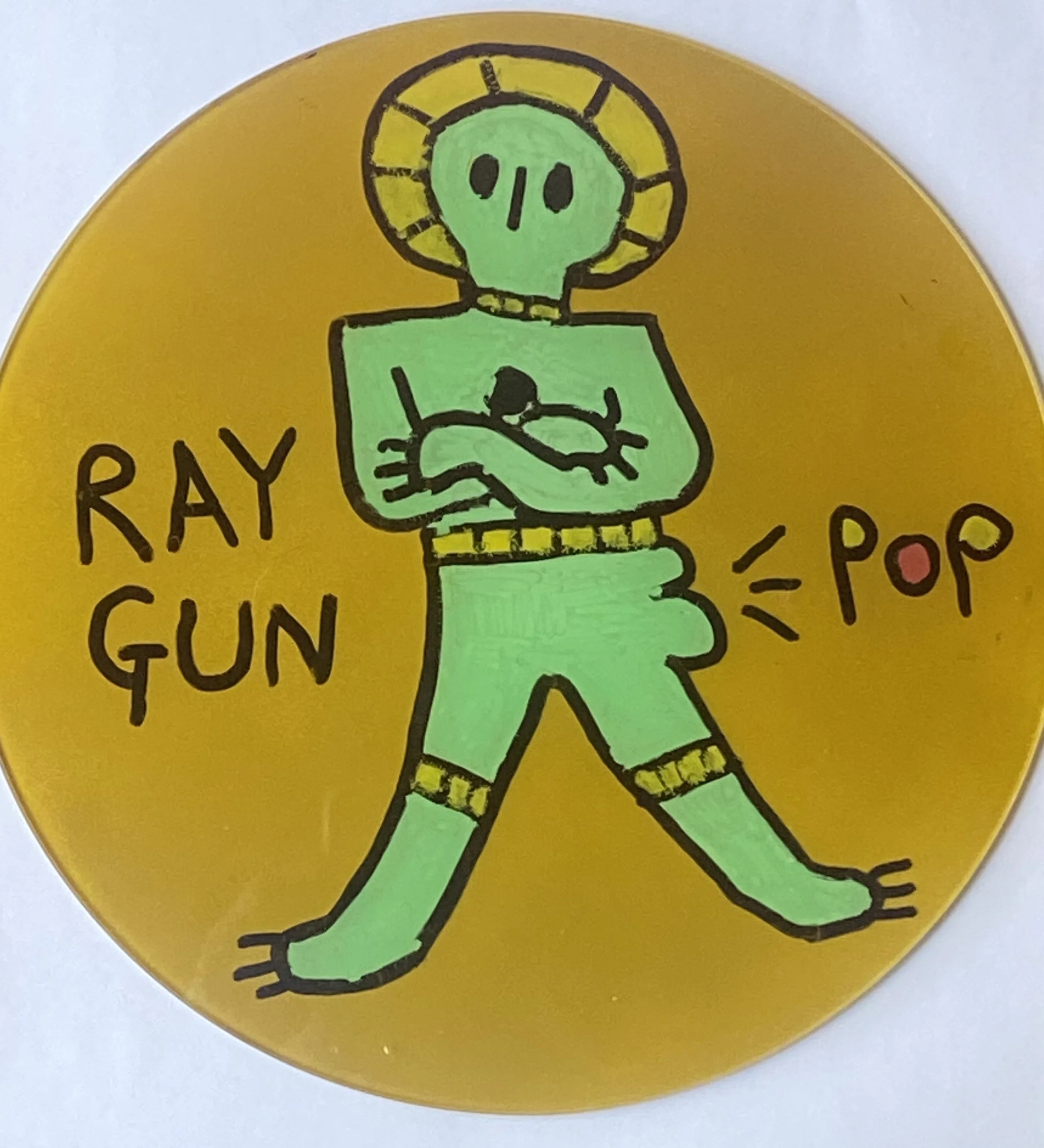
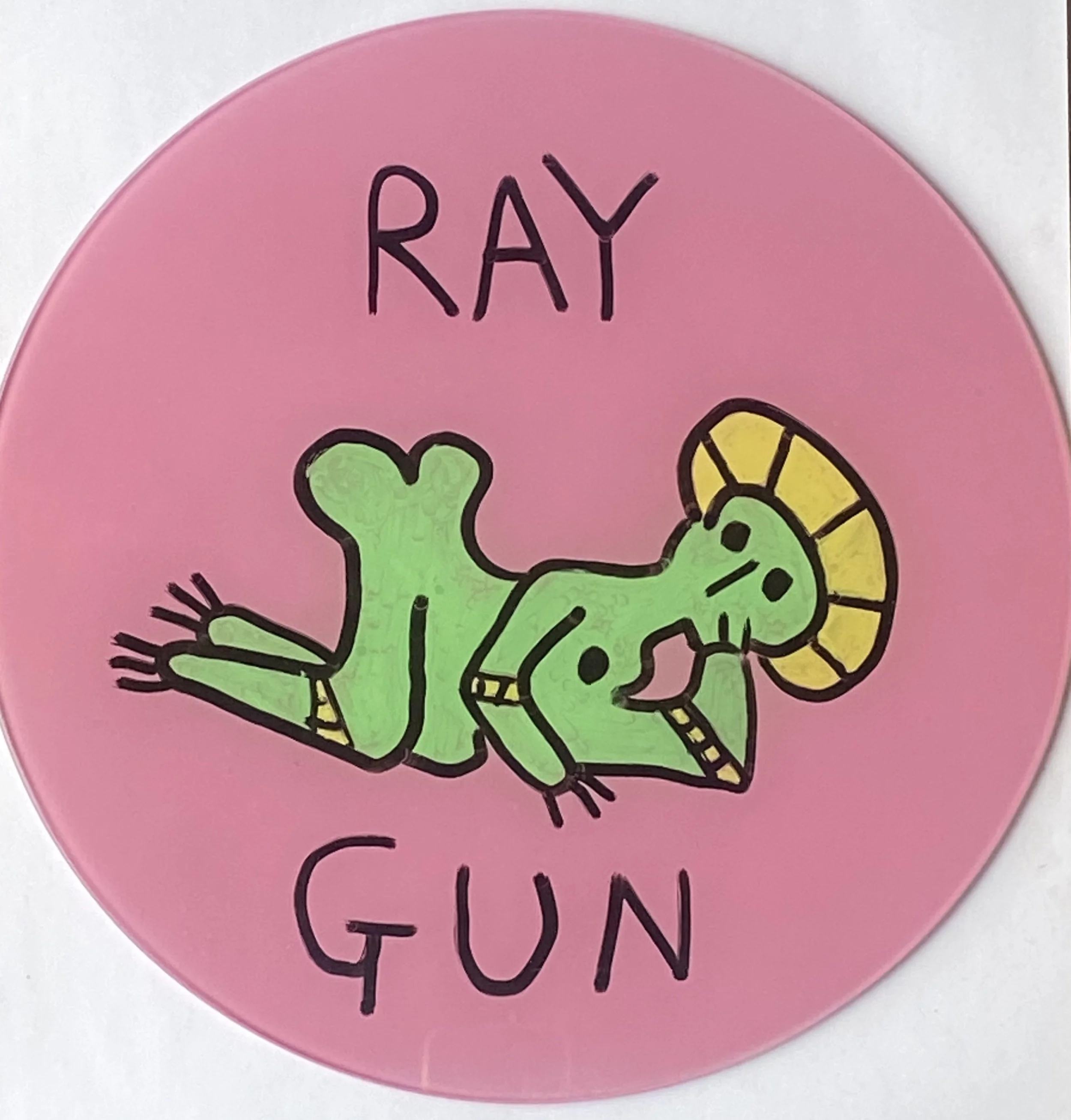
Raygun Series (2024–25)
Hand-painted acrylic on 30 cm glass discs
$725 each (includes spring-loaded wall hanger)
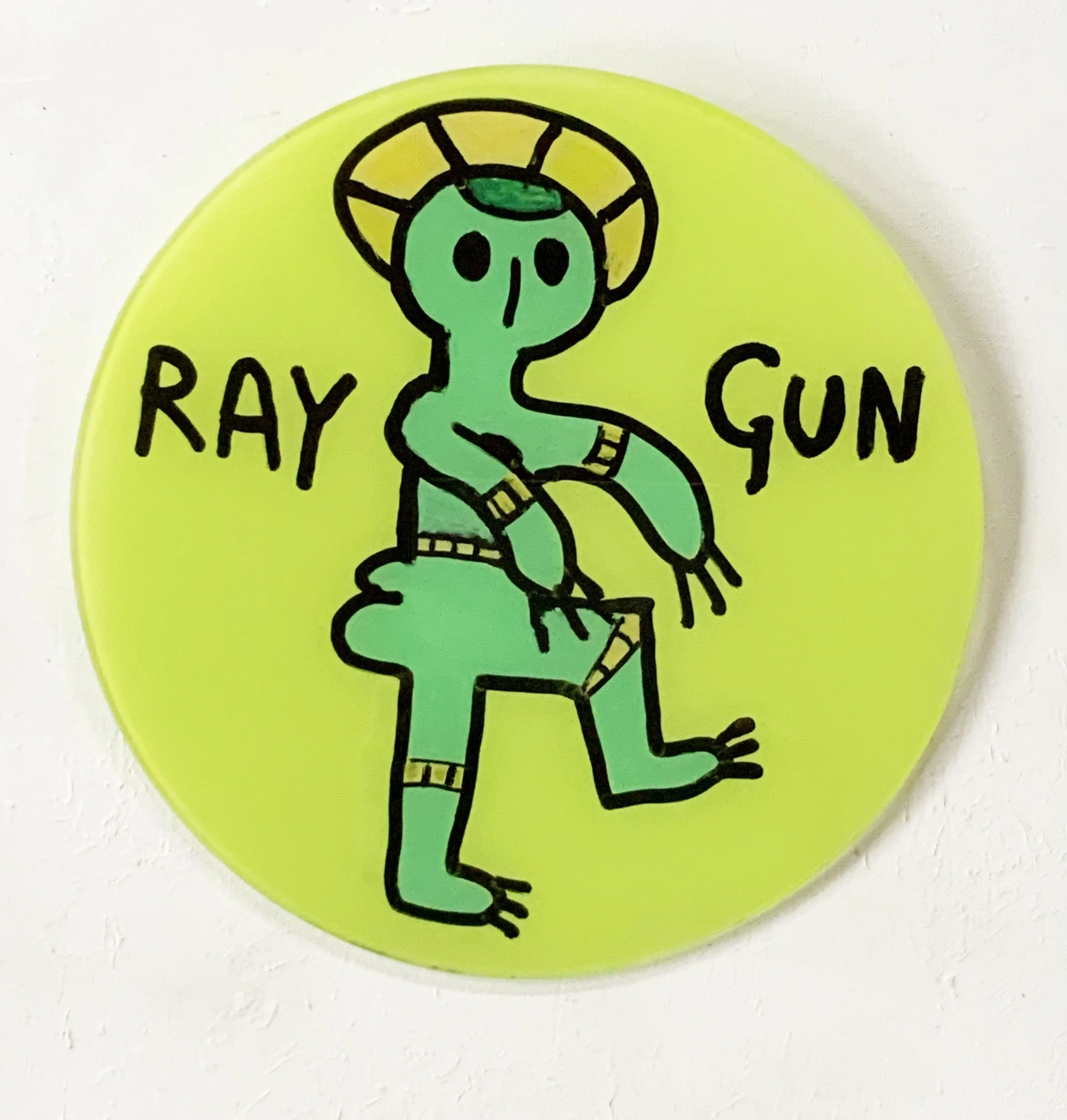
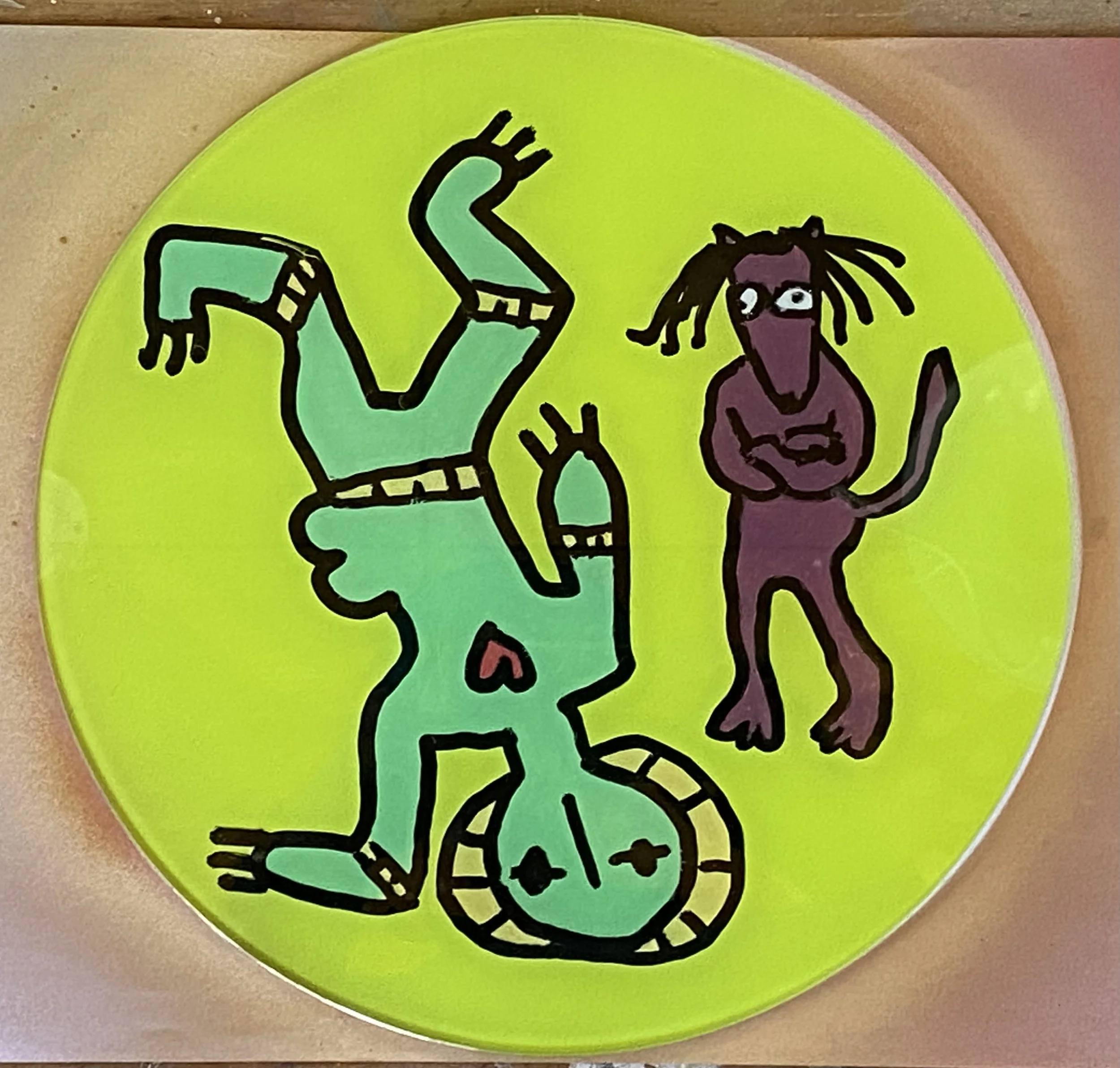
The Raygun Series explodes out of Australia’s 2024 Olympic moment, when breakdancing finally hit the world stage—and the nation watched in equal parts awe, disbelief, and delight. Driller channels this energy through a cast of green-and-gold, Haring-esque figures whose bodies bend, freeze, and pop in impossible configurations.
These characters—half mascot, half cosmic dancer—reference Australia’s breakout breakers while also nodding to the way global pop culture collapsed into the event: from televised commentary to Snoop Dogg’s now-iconic reactions, hovering at the edge of every screen like a benevolent trickster.
Rendered with thick black linework and flat, saturated colour, the works merge two cultural languages:
1. Keith Haring’s joyous, vibrating figure-drawing, and
2. Australia’s eternal sporting palette—green, gold, and big characters with bigger attitudes.
The glass disc format turns each dancer into a floating emblem, a circular badge of movement and play. Their postures—strutting, spinning, leaning, reclining—serve as both celebration and satire, a POP reframing of athletic heroism filtered through Driller’s unmistakable humour and outsider figuration.
These works aren’t just about breakdancing; they’re about the cultural swirl surrounding it—Australian identity, global spectatorship, and the strange intimacy of watching a nation dance for the world.
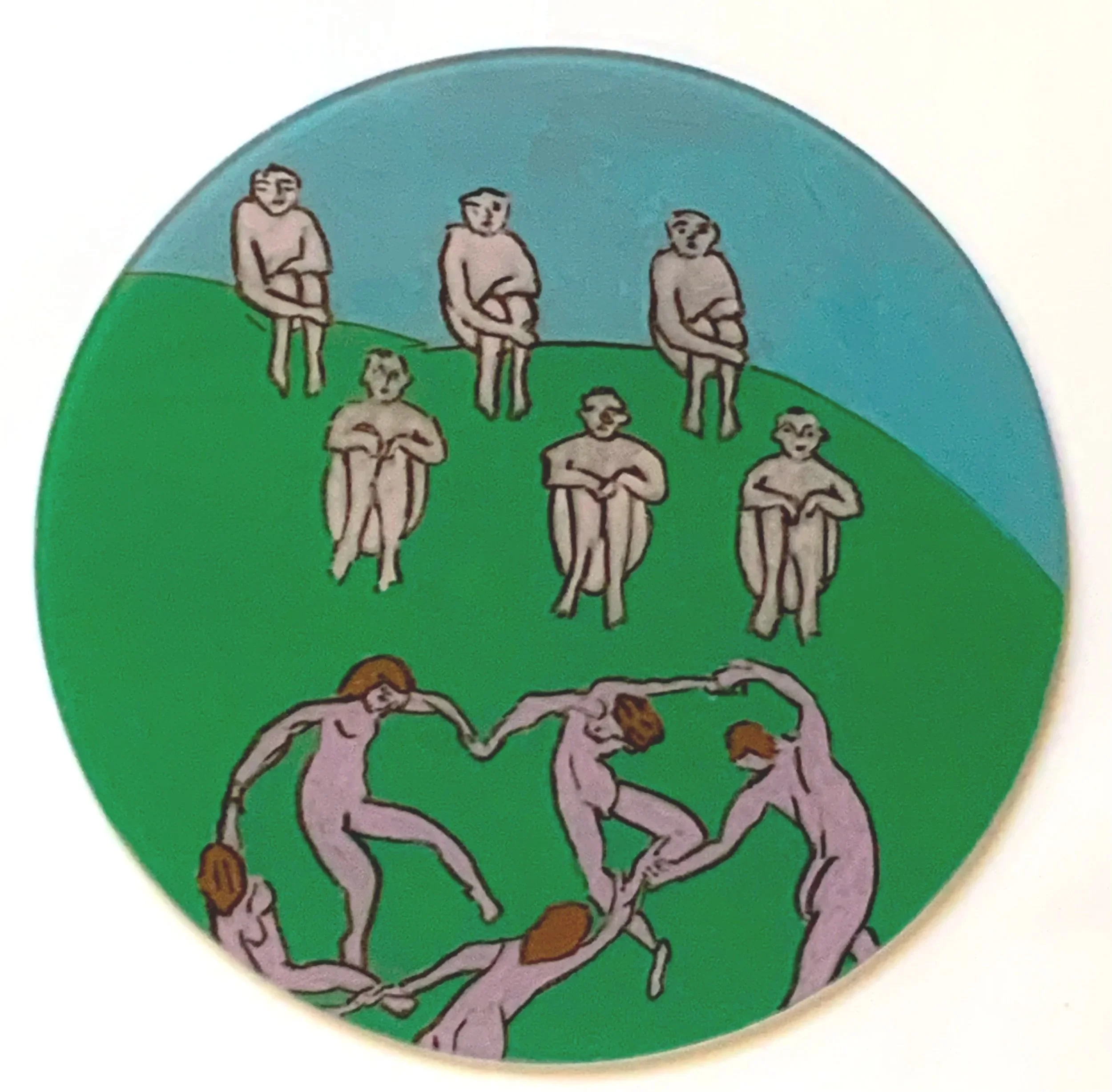
Dancing for Henri (2025)
Hand-painted acrylic on 30 cm glass disc
$725 (includes spring-loaded wall hanger)
A playful homage to Henri Matisse’s Dance, this work stages a ring of naked figures spiralling across a green field while a silent audience of seated onlookers observes from above. The piece blends Matisse’s ecstatic movement with Driller’s trademark humour—those squat little spectators, half-monkey, half-monument, giving the modernist masterpiece a suburban twist.
A joyful collision of high art and everyday absurdity, Dancing for Henri turns the entire scene into a circular, floating tribute to rhythm, bodies, and the ongoing conversation between artists across time.
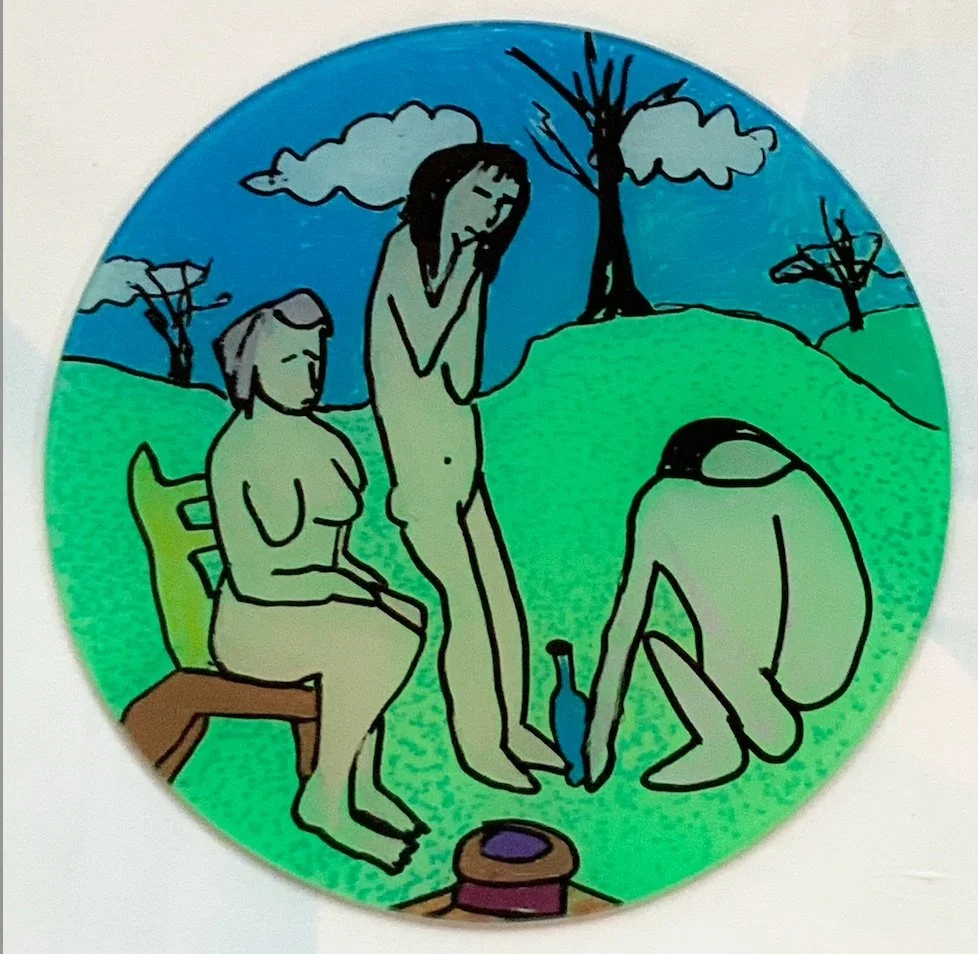
Drinking in the Park (2025
Hand-painted acrylic on 30 cm glass disc
$725 (includes spring-loaded wall hanger)
In Drinking in the Park, Driller reframes the pastoral gathering through a deliberately naïve visual language. Three figures occupy a stylised hillside, their postures echoing both Manet’s Déjeuner sur l’herbe and the quiet ambivalence of contemporary public space. The simplified forms, flattened perspective, and hovering bottle introduce a gentle absurdity, positioning the scene somewhere between art-historical citation and everyday vernacular leisure.
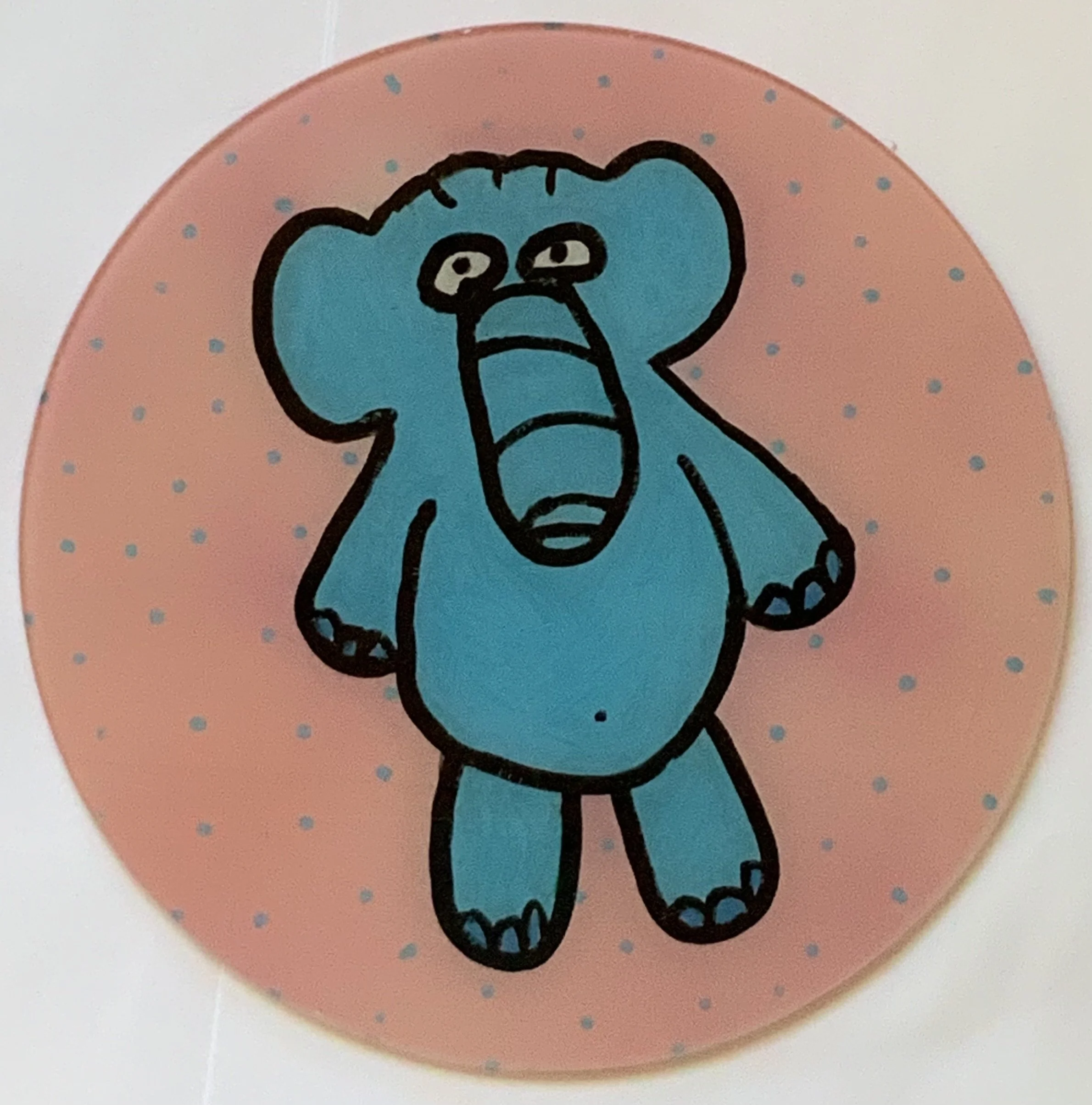
Elly (2025)
Hand-painted acrylic on 30 cm glass disc
$725 (includes spring-loaded wall hanger)
Driller renders a stylised blue elephant with the disarming directness of children’s drawing, collapsing cuteness and abstraction into a single iconic form. Set against a lightly punctuated pink ground, the figure hovers between mascot, toy, and pop-symbol.
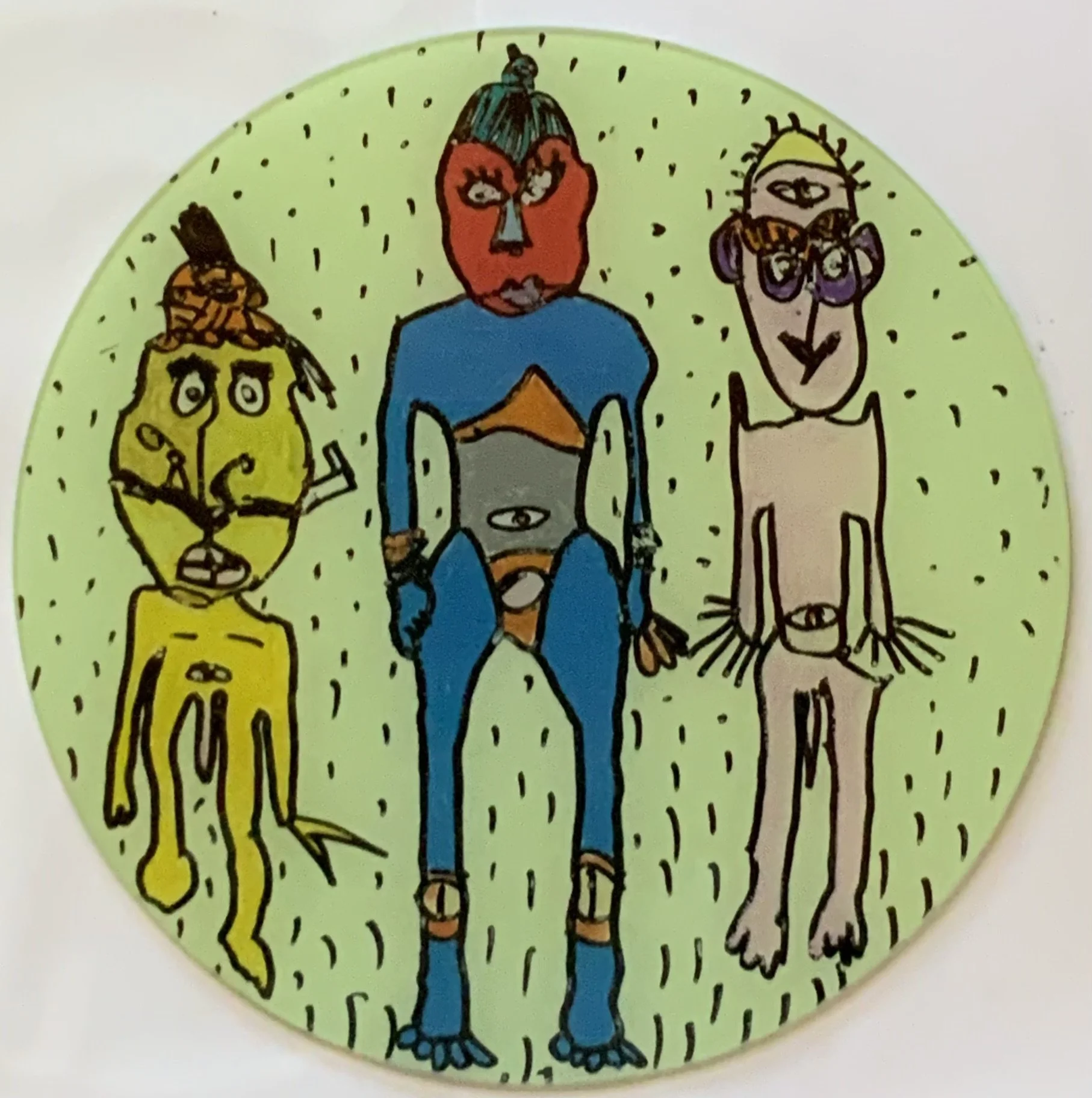
The Primitives (2024)
Hand-painted acrylic on 30 cm glass disc
$725 (includes spring-loaded wall hanger)
A trio of eccentric, one-eyed humanoids stands in a sparse field, fusing tribal futurism with the raw immediacy of outsider drawing.