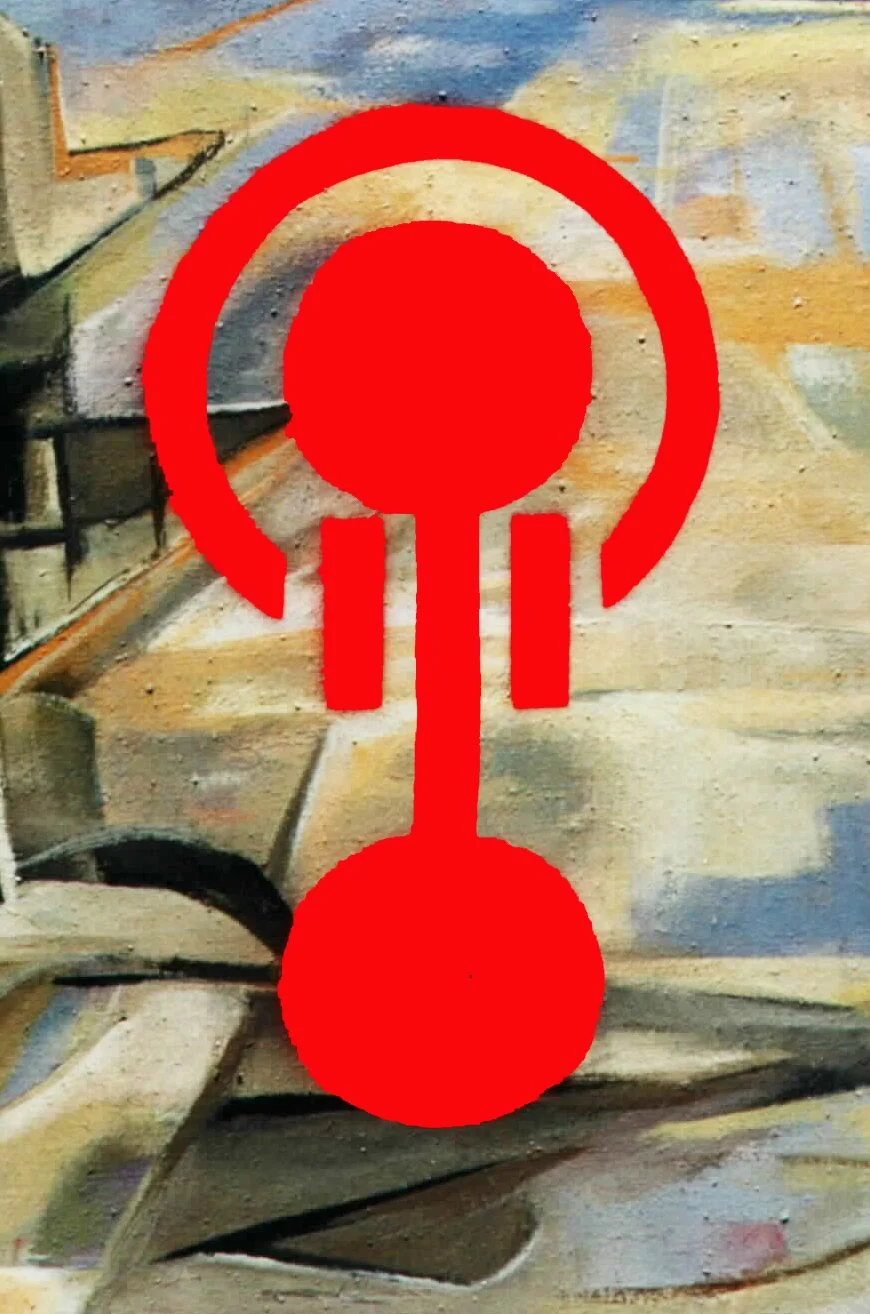
The First Daub: Symbol, Landscape, and Cultural Interruption
The origins of Daubism can be traced to a single intervention made in 1991, when Armstrong inserted a crop-circle motif onto an existing landscape painting by the late South Australian artist Charles Bannon. The painting depicted what was then commonly referred to as The Olgas — now more accurately known by its Anangu name, Kata Tjuṯa.
This act established the conceptual DNA of Daubism.
The intervention did not attempt to erase the original work. Instead, it introduced an alien visual language into an inherited image — a geometric symbol suggestive of ritual, communication, or cosmology. The crop-circle motif possessed the appearance of meaning without offering explanation. Like many crop-circle formations documented internationally, it seemed intentional, structured, and culturally resonant, yet ultimately undecipherable.
When seen in groups, crop-circle images appear almost linguistic — different yet related, forming a speculative system of signs. Armstrong recognised this phenomenon intuitively. By placing such a symbol onto an Australian landscape already layered with colonial naming histories and cultural displacement, the gesture created a powerful collision between narratives: Western landscape tradition, Indigenous geography, popular myth, and contemporary speculation.
The daub functioned as an interruption — not destructive but transformative. The painting remained recognisable, yet its meaning shifted irrevocably. Authorship became plural. Time collapsed. Certainty dissolved.
In retrospect, this first daub contained the core principles that would define Armstrong’s practice for more than three decades:
Intervention into pre-existing imagery
Symbolic ambiguity and open interpretation
Dialogue between cultural histories
Reframing of authorship
Minimal gesture with maximal conceptual consequence
What began as an intuitive act would become a sustained artistic methodology. The crop-circle intervention was not simply the first Daub — it was the moment in which Daubism itself came into being.